Pharmaceutical Analysis Is Science — From STEM to STEAM
Every year this course opens with a question that sounds settled but isn’t: is what we do a science, or is it just a set of techniques we run? Your answer shapes how you’ll spend the next sixteen weeks — and, frankly, your career.
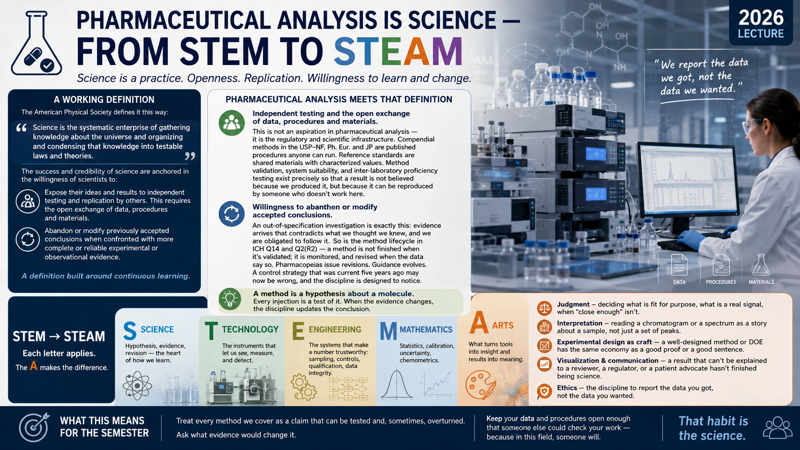
A working definition
The American Physical Society defines it this way:
Science is the systematic enterprise of gathering knowledge about the universe and organizing and condensing that knowledge into testable laws and theories.
The success and credibility of science are anchored in the willingness of scientists to:
- Expose their ideas and results to independent testing and replication by others. This requires the open exchange of data, procedures and materials.
- Abandon or modify previously accepted conclusions when confronted with more complete or reliable experimental or observational evidence.
I like this definition because it doesn’t lead with test tubes or equations. It leads with a set of commitments — to openness, to replication, and to changing your mind. That is a definition built around continuous learning.
Pharmaceutical analysis meets that definition
Hold our field up against those two commitments and it lines up point for point.
Independent testing and the open exchange of data, procedures and materials. This is not an aspiration in pharmaceutical analysis — it is the regulatory and scientific infrastructure. Compendial methods in the USP–NF, Ph. Eur. and JP are published procedures anyone can run. Reference standards are shared materials with characterized values. Method validation, system suitability, and inter-laboratory proficiency testing exist precisely so that a result is not believed because we produced it, but because it can be reproduced by someone who doesn’t work here.
Willingness to abandon or modify accepted conclusions. An out-of-specification investigation is exactly this: evidence arrives that contradicts what we thought we knew, and we are obligated to follow it. So is the method lifecycle in ICH Q14 and Q2(R2) — a method is not finished when it’s validated; it is monitored, and revised when the data say so. Pharmacopeias issue revisions. Guidance evolves. A control strategy that was current five years ago may now be wrong, and the discipline is designed to notice.
A method, in this light, is a hypothesis about a molecule. Every injection is a test of it. When the system suitability fails, when the recovery drifts, when a new impurity appears — the discipline doesn’t ask us to defend the old conclusion. It asks us to update it.
STEM → STEAM
We usually file analytical chemistry under STEM, and each letter genuinely applies:
- Science — the reasoning above: hypothesis, evidence, revision.
- Technology — the instruments: LC, GC, mass spec, NMR, spectroscopy.
- Engineering — the systems that make a number trustworthy: sampling plans, control strategies, qualification, data integrity.
- Mathematics — statistics, calibration, uncertainty, chemometrics.
But the letter that’s usually left out is the one that separates a technician from an analyst. The A — Arts — is not decoration:
- Judgment — deciding what is fit for purpose, what is a real signal, when “close enough” isn’t.
- Interpretation — reading a chromatogram or a spectrum as a story about a sample, not just a set of peaks.
- Experimental design as craft — a well-designed method or DOE has the same economy as a good proof or a good sentence.
- Visualization and communication — a result that can’t be explained to a reviewer, a regulator, or a patient advocate hasn’t finished being science.
- Ethics — the discipline to report the data you got, not the data you wanted.
STEM gives you the tools. The A is what you bring to them.
What this means for the semester
Treat every method we cover as a claim that can be tested and, sometimes, overturned. Ask what evidence would change it. Keep your data and procedures open enough that someone else could check your work — because in this field, someone will. That habit is the science.