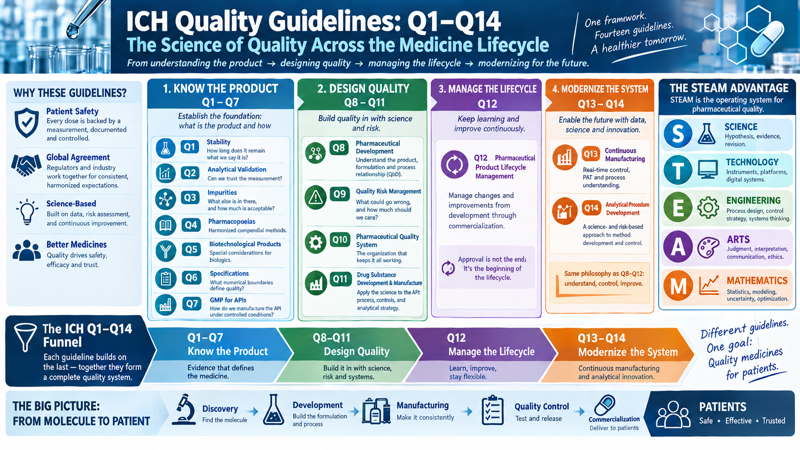
The ‘regs’ end of the funnel: how ICH guidelines, the pharmacopeias, and agency expectations shape every analytical decision — from method design to release.
What ICH is — the International Council for Harmonisation of Technical Requirements for Pharmaceuticals for Human Use; who its members and observers are; why harmonisation exists (one dataset, multiple markets).
Every choice you defended on scientific grounds in Sections 1–2 now has to survive a second audience: an inspector reading your data cold, years later, deciding whether patients can trust it.
A deep dive into ICH Q1: the purpose of stability testing and the discipline of a systematic program, stress testing versus R&D forced degradation, the chemistry of drug degradation, an integrated forced/accelerated/long-term design, storage conditions, significant change, climatic zones, reduced designs, data evaluation, and the modernized Q1 revision.
A deep dive into ICH Q2(R2): validation as the demonstration that a measurement is fit for its intended purpose — the analytical procedure as a measurement system, the four procedure types, the analytical figures of merit and their formal definitions (accuracy, precision, specificity, detection and quantitation limits, linearity, range, robustness), which characteristics are required for which test type, the R2 reframing around reportable range and multivariate procedures, stability-indicating methods, platform methods, and validation’s place in the Q14 analytical procedure lifecycle.
A deep dive into the Q3 family: what counts as an impurity and how impurities are classified (organic — process- and drug-related, inorganic, residual solvents), the reporting / identification / qualification threshold ladder and why it scales with daily dose, Q3A for the drug substance and Q3B for degradation products in the drug product, what qualification and identification actually demand of the analyst, Q3C residual solvents (the four classes, PDE, Option 1 vs Option 2, the R9 volatility update), Q3D elemental impurities (24 elements, the class 1/2A/2B/3 scheme, PDEs by route, the 30 % control threshold, the risk assessment that replaced USP <231>), the M7 mutagenic-impurity overlay (TTC, (Q)SAR, the five structural classes, the cohort of concern, nitrosamines and M7(R3)), and how the whole set feeds the specification (Q6) and the analytical method (Q2).
The Q4 family and the compendial baseline: what a pharmacopoeia is and how a monograph differs from a general chapter, the three ICH-region pharmacopoeias (USP–NF, Ph. Eur., JP) and the Pharmacopoeial Discussion Group that harmonises their shared texts, why full harmonisation (Q4A) stalled and the evaluate-and-recommend mechanism (Q4B) that replaced it, what ‘interchangeable’ actually means and the region-specific text that remains, the fourteen Q4B annexes and the general chapters they cover, and what compendial status demands of the analyst — verification under USP <1226>, the rules for a validated alternative method, and when the compendial method is mandatory.
A deep dive into the Q5 family — the guidelines that govern how a biotechnological product is generated and characterised: why ’the product is the process’ for a protein made in living cells, microheterogeneity and the critical quality attributes it creates, Q5A viral safety (the three-pillar strategy — testing the cell substrate and raw materials, demonstrating viral clearance, testing the bulk — plus log reduction factors, retrovirus-like particles and the R2 scope expansion), Q5B verification and genetic stability of the expression construct, Q5C stability testing of proteins (aggregation, deamidation, oxidation, clipping, and potency by bioassay) and its absorption into the modernised Q1, Q5D derivation and characterisation of cell substrates and the two-tiered master/working cell bank system with the limit of in vitro cell age, Q5E comparability after a manufacturing change — ‘comparable’ rather than ‘identical’, the analytical-first weight of evidence, and its role as the scientific basis for biosimilars — and how the whole set feeds the specification (Q6B), the development story (Q11) and the analytical method (Q2).
The Q6 family and the release contract: what a specification is (a list of tests, references to analytical procedures, and acceptance criteria) and why it confirms quality rather than creating it, how specifications evolve from wide and provisional in early development to tight and fully justified at filing as uncertainty is retired, the certificate of analysis as the specification applied to one batch, Q6A for chemical substances — the universal tests, the dosage-form-specific tests, and the decision trees for polymorphism, chirality, impurities, degradation products, residual solvents, microbial limits and dissolution — Q6B for biotechnological products — characterisation versus routine testing, product-related substances versus impurities, potency and the in-house reference standard — and the concepts that decide where a limit sits: process capability versus clinical relevance, release versus shelf-life acceptance criteria, periodic (skip) testing, parametric release, and real-time release testing, plus how the specification gathers up Q1, Q3 and Q5 and hands the result to Q2 and batch release.
ICH Q7 as the GMP floor under the whole quality system: what ‘an appropriate system for managing quality’ actually requires — the independent quality unit and its non-delegable duties, where GMP begins in an API route (Table 1) and why stringency rises toward the final steps, and the concrete controls each numbered section demands: personnel, buildings and facilities, process equipment and calibration, documentation and data integrity (ALCOA+), materials management and supplier qualification, production and in-process controls, packaging and label control, storage and distribution, laboratory controls (impurity profile, CoA, stability monitoring, reserve samples, OOS), validation and cleaning validation, change control, reprocessing versus reworking, complaints and recalls, contract manufacturers, the distribution chain, cell culture / fermentation, and investigational APIs — with the analyst’s obligations called out throughout.
The QbD and lifecycle family read as one story: pharmaceutical development (Q8) and quality by design — the quality target product profile, critical quality attributes, and the design-space methods that build causality from process parameters to quality attributes (first principles, designed experiments, scale-up correlations, FMECA); quality risk management (Q9) and criticality analysis as the way a complex process is reduced to what matters; the pharmaceutical quality system (Q10); development and manufacture of drug substances (Q11) and starting-material justification; lifecycle management (Q12) with established conditions and the PLCM document; how a pharmaceutical development section is written into the CTD (risk management, design space, control strategy, drug-substance information); and the business case for QbD — assurance, efficiency, innovation, and lighter post-approval and inspection burden.
Q13: continuous manufacturing of drug substances and products — what ‘continuous’ changes (residence time distribution, state of control, material traceability), the cost–benefit rationale for adopting it, the control-strategy elements Q13 adds, real-time release testing and the model lifecycle, batch definition and diversion of non-conforming material, the approved products that pioneered it, and the analytical shift from batch pulls to in-line measurement.
A deep dive into ICH Q14: analytical quality by design — the analytical target profile as the method’s QTPP, minimal versus enhanced development, selecting the technique from sample and analyte properties, risk assessment of analytical procedure parameters (fishbone, FMEA), robustness by design of experiments, the method operable design region as the analytical design space, the analytical control strategy and system suitability, platform and multivariate procedures, and the analytical procedure lifecycle — established conditions, reportable range, and the regulatory flexibility that Q12 and Q2(R2) hang off it.