ICH Q3 — Impurities
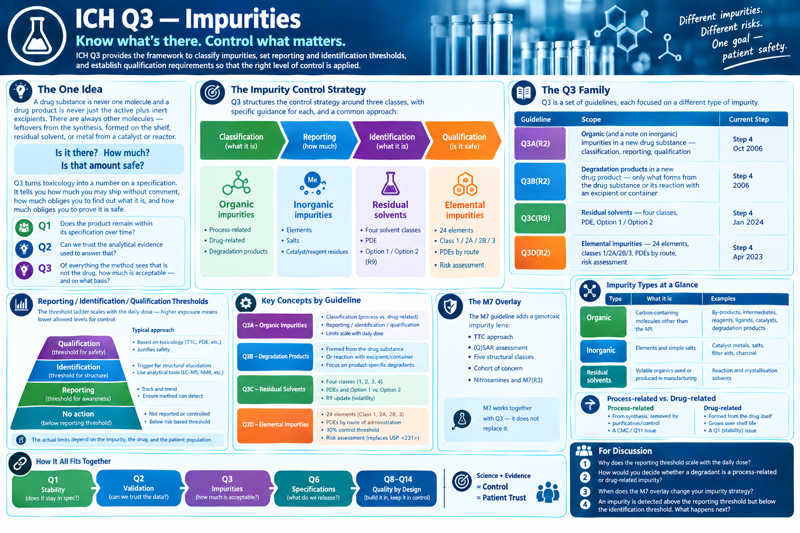
The one idea
A drug substance is never one molecule and a drug product is never just the active plus inert excipients. Alongside the thing you are selling there is always a population of other molecules — leftovers from the synthesis, things the molecule turned into on the shelf, solvent that never fully dried off, metal from a catalyst or a reactor wall. Every one of them is a question:
Is it there? How much? Is that amount safe?
Q3 is the framework that answers the third question by turning toxicology into a number on a specification. It says, for a given impurity at a given patient exposure, how much you may ship without further comment, how much obliges you to find out what it is, and how much obliges you to prove it is safe.
This pairs with the two sections before it:
Q1 asks: does the product remain within its specification over time?
Q2 asks: can we trust the analytical evidence used to answer that?
Q3 asks: of everything the method sees that is not the drug, how much is acceptable — and on what basis?
What counts as an impurity
An impurity is any component of the drug substance or drug product that is not the drug substance (or, in the product, an excipient). Q3 sorts them three ways:
| Class | What it is | Where it comes from |
|---|---|---|
| Organic impurities | Carbon-containing molecules other than the API | Starting materials, by-products, intermediates, reagents, ligands, catalysts, and degradation products |
| Inorganic impurities | Elements and simple salts | Reagents, ligands and catalysts (→ elemental impurities, Q3D), inorganic salts, filter aids, charcoal |
| Residual solvents | Volatile organics used or produced in manufacture | Reaction and crystallisation solvents that do not fully evaporate (→ Q3C) |
Two cross-cutting distinctions matter more than the list:
- Process-related vs. drug-related. A process impurity rides in from the synthesis and is (in principle) removed by better process control and purification — it is a Q11 problem, fixed upstream. A degradation product forms from the drug itself and grows over shelf life — it is a Q1 problem, and no amount of upstream purification removes it.
- Specified vs. unspecified. A specified impurity has its own line and its own acceptance criterion on the specification (named, or identified by relative retention). Everything else is caught by two catch-all limits — “any unspecified impurity ≤ identification threshold” and “total impurities ≤ …”. This is the machinery Q6 assembles into the release contract.
The Q3 family
Q3 is not one document — it is a set, split by the kind of impurity:
| Guideline | Scope | Current step |
|---|---|---|
| Q3A(R2) | Organic (and a note on inorganic) impurities in a new drug substance — classification, reporting, the threshold tables, qualification | Step 4, Oct 2006 |
| Q3B(R2) | Degradation products in a new drug product — only what forms from the drug substance or from its reaction with an excipient or the container | Step 4, 2006 |
| Q3C(R9) | Residual solvents — the four solvent classes, permitted daily exposure (PDE), Option 1 / Option 2 limits | Step 4, Jan 2024 |
| Q3D(R2) | Elemental impurities — 24 elements, class 1 / 2A / 2B / 3, PDEs by route of administration, the risk-assessment process | Step 4, Apr 2022 |
| M7(R2) | Mutagenic (DNA-reactive) impurities — a Multidisciplinary guideline, not a “Q”, but the class should know it sits with Q3 | Step 4, Apr 2023 |
The mental model: Q3A/Q3B set the general rules for “ordinary” impurities; Q3C, Q3D and M7 carve out three categories that need their own toxicology because a percentage-of-the-API limit is the wrong tool for them.
The challenge: a moving target
The same difficulty that shadows Q1 and Q2 applies here. The impurity profile is a function of the process, and the process changes throughout development — a new route, a new supplier of a starting material, a scale-up, a site change, a different final crystallisation. Each change can add an impurity, remove one, or shift a ratio. An impurity that was below the reporting threshold in the tox batches can appear at 0.2 % in the first commercial-scale lot.
When everything around the molecule is changing, standardise how you track what is not the molecule.
The defence is the same discipline Q1 and Q2 demand: a fixed, validated, specific method that resolves the known impurities, a fixed reporting convention, and a documented impurity fate map so that when a new peak appears you can say whether it is new chemistry or a known impurity that moved.
The core concept: three thresholds
This is the idea to fix for graduate students. For any impurity, its measured level falls into one of four bands, and the band — not a single universal limit — dictates what you owe:
| Band | Level | What is required |
|---|---|---|
| Below the reporting threshold | trace | Nothing — it need not even appear in the registration application |
| At or above reporting, below identification | small | Report the actual result (a number, not “< X”) in the batch analyses |
| At or above identification, below qualification | moderate | Identify the impurity — establish its structure |
| At or above qualification | large | Qualify it — provide data establishing biological safety at that level |
Two features make this elegant rather than arbitrary:
- The thresholds scale with exposure. They are expressed as a percentage of the drug substance or as an absolute daily intake (µg or mg per day), whichever is lower. A 5 mg tablet and a 1 g tablet do not get the same percentage limit, because the patient’s actual dose of the impurity is what matters.
- The ladder is cumulative. Anything you must qualify, you must first have identified and reported. Each rung is a stricter scientific claim: I saw it → I know what it is → I know it is safe.
Q3A — impurities in the new drug substance
Q3A(R2) applies to the drug substance made by chemical synthesis (not biologics — that is Q6B). It asks the applicant to:
- Summarise the actual and potential impurities most likely to arise from the synthesis, purification, and storage, with a rationale for each based on the chemistry;
- List the impurities found in development and toxicology batches, with the analytical procedures used;
- Classify each as an identified/unidentified organic impurity, a residual solvent, or an inorganic impurity;
- Set acceptance criteria for individual specified impurities, any unspecified impurity, and total impurities.
The threshold table (drug substance):
| Maximum daily dose | Reporting threshold | Identification threshold | Qualification threshold |
|---|---|---|---|
| ≤ 2 g/day | 0.05 % | 0.10 % or 1.0 mg/day intake (whichever is lower) | 0.15 % or 1.0 mg/day intake (whichever is lower) |
| > 2 g/day | 0.03 % | 0.05 % | 0.05 % |
Read the “>2 g/day” row as the safety net: at very high doses even a small percentage is a large absolute intake, so the thresholds tighten.
Q3B — degradation products in the new drug product
Q3B(R2) is deliberately narrower than Q3A. In the finished product it covers only:
- degradation products of the drug substance formed during manufacture or storage of the product, and
- reaction products of the drug substance with an excipient or with the container closure system.
It explicitly does not cover: impurities carried in from the drug substance process, impurities in the excipients themselves, extractables/leachables (a separate discipline), or polymorphic and enantiomeric changes. The logic: the product-stability method should be watching for new chemistry that happens after the drug substance is released — which is exactly the stability-indicating capability that Q1 forced degradation and Q2 specificity exist to demonstrate.
The threshold tables (drug product) are more granular than Q3A because product doses span a wider range. “TDI” is the total daily intake of the degradation product, and “whichever is lower” always applies.
Reporting threshold:
| Maximum daily dose | Threshold |
|---|---|
| ≤ 1 g | 0.1 % |
| > 1 g | 0.05 % |
Identification threshold:
| Maximum daily dose | Threshold |
|---|---|
| < 1 mg | 1.0 % or 5 µg TDI |
| 1 mg – 10 mg | 0.5 % or 20 µg TDI |
| > 10 mg – 2 g | 0.2 % or 2 mg TDI |
| > 2 g | 0.10 % |
Qualification threshold:
| Maximum daily dose | Threshold |
|---|---|
| < 10 mg | 1.0 % or 50 µg TDI |
| 10 mg – 100 mg | 0.5 % or 200 µg TDI |
| > 100 mg – 2 g | 0.2 % or 3 mg TDI |
| > 2 g | 0.15 % |
Qualification — turning a number into a safety judgment
Qualification is the process of acquiring and evaluating data that establishes the biological safety of an individual impurity or a given impurity profile at the level(s) specified. It is not automatically a new toxicology study. The Q3A/Q3B decision tree offers, roughly in order of preference:
- Is the level already covered? If the impurity is also a significant metabolite of the drug, or is present at a comparable level in a batch already tested in humans or animals, it is considered qualified.
- Is it below the qualification threshold? Then no action is needed unless it carries a structural alert for unusual toxicity or genotoxicity (→ M7).
- If above the threshold and not otherwise qualified: reduce it (better process or formulation), or generate data — typically a genotoxicity screen (bacterial mutagenicity + one chromosomal-damage assay) and a general toxicity study (usually ≥ 14 days, in a relevant species) at a dose that gives the required exposure margin.
The teaching point: qualification is a risk-based off-ramp, not a mandatory battery. Most impurities are qualified by argument and existing data; only the genuinely novel, genuinely abundant ones drive new studies.
Identification — what “identify” actually demands
To “identify” an impurity is to establish its structure — not merely to give it a relative retention time and a code. This is step 7 of the degradant-profiling workflow from the Q1 lecture, and it uses the same tools:
| Tool | What it gives |
|---|---|
| LC–MS / LC–MSn | Molecular formula from accurate mass; fragmentation map; often enough to propose a structure for a degradant related to a known parent |
| LC–NMR / preparative isolation + NMR | Connectivity and stereochemistry — needed when the mass is unchanged (isomerisation, rearrangement) or ambiguous |
| Preparative chromatography / synthesis of the authentic standard | A reference material to confirm identity by co-elution and to use for accurate quantitation |
| Orthogonal separation | Confirms one peak is one compound (peak purity), and that co-eluting impurities are not being missed |
An unidentified impurity above the identification threshold is a finding the application has to explain: what was tried, why the structure could not be assigned, and why the safety argument still holds.
Q3C — residual solvents
Solvents are treated separately because their toxicity is known and dose-based, not a function of “percent of API”. Q3C(R9) sorts solvents into four classes:
| Class | Meaning | Basis | Examples (limit) |
|---|---|---|---|
| Class 1 | Avoid | Known/suspected human carcinogens; environmental hazards | Benzene (2 ppm), carbon tetrachloride (4 ppm), 1,2-dichloroethane (5 ppm), 1,1-dichloroethene (8 ppm), 1,1,1-trichloroethane (1500 ppm) |
| Class 2 | Limit | Non-genotoxic animal carcinogens; agents of irreversible toxicity (neuro-, teratogenic) | Acetonitrile (PDE 4.1 mg/day), methanol (30), dichloromethane (6.0), toluene (8.9), n-hexane (2.9), DMF (8.8) |
| Class 3 | Low concern | Low toxic potential; PDE ≥ 50 mg/day | Acetone, ethanol, ethyl acetate, isopropanol, 1-propanol, MEK — ≤ 5000 ppm (0.5 %) acceptable without justification |
| Class 4 | No data | No adequate toxicological data | Isopropyl ether, methylisopropyl ketone, petroleum ether — justify case by case |
PDE (permitted daily exposure) is the anchor. It is derived from a no-effect level in the most relevant animal study, scaled to a 50 kg adult and divided by a stack of five safety factors (interspecies extrapolation, individual variability, short-study correction, severe-toxicity correction, and a NOEL-vs-LOEL adjustment):
PDE = (NOEL × 50 kg) / (F₁ × F₂ × F₃ × F₄ × F₅)
For Class 2 solvents there are two ways to set a limit:
- Option 1 — a fixed concentration limit (ppm), computed assuming a maximum product intake of 10 g/day. Simple; conservative for low-dose products.
- Option 2 — back-calculate an allowed concentration from the actual maximum daily dose of the product, so the daily amount of solvent meets the PDE. More generous when the real dose is well under 10 g.
R9 (minor revision, January 2024) added consideration of solvent volatility when choosing and validating the analytical method (headspace GC behaviour differs sharply between, say, methanol and DMSO), and refreshed the Annex decision trees.
Q3D — elemental impurities
Q3D(R2) replaced the century-old USP <231> heavy-metals test — a non-specific colorimetric sulfide-precipitation assay with poor and element-dependent recovery — with a risk-based, element-specific framework, implemented analytically by USP <232> (limits) and <233> (ICP-OES / ICP-MS procedures).
24 elements, four classes:
| Class | Elements | Toxicity / occurrence | Assessment |
|---|---|---|---|
| 1 | As, Cd, Hg, Pb | Highly toxic; enter via mined/natural excipients and water | Required for all routes |
| 2A | Co, Ni, V | Higher probability of occurrence | Required for all routes |
| 2B | Ag, Au, Ir, Os, Pd, Pt, Rh, Ru, Se, Tl | Low probability unless intentionally added (catalysts) | Only if added |
| 3 | Ba, Cr, Cu, Li, Mo, Sb, Sn | Low oral toxicity (oral PDE > 500 µg/day) | Parenteral & inhalation routes |
PDEs are set per route of administration — oral, parenteral, inhalation, and (added in R2) cutaneous and transcutaneous — because absorption differs by orders of magnitude. The control threshold is 30 % of the PDE: if an element is consistently below that across representative batches, no additional controls are needed.
The heart of Q3D is the risk assessment, not a test:
- Identify known and potential sources — drug substance, each excipient, water, reagents, manufacturing equipment (reactor alloys, catalysts), container closure system.
- Evaluate the likely contribution of each source against the PDE, using data, prior knowledge, and worst-case additivity.
- Summarise and document the conclusion and any controls; test routinely only where the assessment cannot rule out a problem.
R2 (2022) revised the PDEs for gold, silver and nickel and added the cutaneous/transcutaneous routes.
Options for turning a PDE into a per-component concentration limit mirror Q3C: Option 1 (a common limit assuming 10 g/day intake), Option 2a (common limit at the actual daily dose), Option 2b (component-specific limits summing to the PDE), Option 3 (measure the finished product).
M7 — the mutagenic-impurity overlay
Some impurities are dangerous at levels far below any Q3A/Q3B threshold because they are DNA-reactive — a single molecule can cause a mutation. A “0.10 %” identification threshold is meaningless for a compound whose safe intake is measured in micrograms per day. M7(R2) handles these.
- Acceptable intake: the threshold of toxicological concern (TTC) of 1.5 µg/day, corresponding to a theoretical excess lifetime cancer risk of 1 in 100 000.
- Hazard assessment: database and literature search, then two complementary (Q)SAR methodologies — one expert rule-based, one statistical. Concordance (or an expert overruling) drives the call.
- Five structural classes:
| Class | Definition | Control |
|---|---|---|
| 1 | Known mutagenic carcinogen | Compound-specific limit |
| 2 | Known mutagen (bacterial), carcinogenicity unknown | ≤ TTC |
| 3 | Structural alert, unrelated to the drug substance, no data | ≤ TTC, or run a bacterial mutagenicity assay → if negative, treat as Class 5 |
| 4 | Structural alert shared with the (non-mutagenic) drug substance | Treat as a non-mutagenic impurity — Q3A/Q3B |
| 5 | No structural alert, or data show no mutagenicity | Treat as a non-mutagenic impurity — Q3A/Q3B |
- Cohort of concern — N-nitroso compounds, aflatoxin-like compounds, alkyl-azoxy compounds — are so potent that the generic TTC does not protect; they need compound-specific limits derived from their own carcinogenicity data.
- Less-than-lifetime (LTL) limits — shorter exposures get proportionally higher daily limits (e.g. ≤ 1 month → 120 µg/day; > 1–12 months → 20 µg/day; > 1–10 years → 10 µg/day), useful in clinical development.
- M7(R3), in progress — folds in an N-nitrosamine addendum built on the Carcinogenic Potency Categorisation Approach (CPCA), which scores a nitrosamine’s structural features to place it in a potency category and assign an acceptable intake. This is the ICH response to the 2018-onward nitrosamine recalls (valsartan/NDMA, ranitidine/NDMA).
How the pieces fit — the impurity control strategy
Q3 is not read in isolation; it is one layer of a control strategy that runs the length of the course:
Q11 — choose starting materials and design the route so that process impurities are formed late enough, or purged efficiently enough, to be controlled
↓
Q3A / Q3C / Q3D — characterise and limit the process impurities, residual solvents, and elemental impurities that remain in the drug substance
↓
Q1 — forced degradation and stability studies reveal which impurities grow over shelf life
↓
Q3B — limit the degradation products in the finished product; M7 overlays a stricter limit on any impurity or degradant that is DNA-reactive
↓
Q6 — assemble the acceptance criteria into the release specification: specified impurities, unspecified-impurity limit, total impurities
↓
Q2 — validate the method that has to see every one of these at its limit, batch after batch
What Q3 demands of the analytical method
Every Q3 number is only real if a method can measure it. The chain of consequences for the analyst:
- Sensitivity. The quantitation limit must sit at or below the reporting threshold — you cannot report “0.06 %” from a method whose QL is 0.1 %. This is the direct link to the Q2 detection/quantitation-limit discussion.
- Specificity. Each specified impurity must be resolved from the API and from every other specified impurity; peak purity has to be demonstrated for the main peak and for any impurity used to set a limit.
- Relative response factor (RRF). An impurity quantified against the API peak is only accurate if its detector response per unit mass is known. Either measure the RRF and apply a correction, or demonstrate the response is equivalent (within, say, 0.8–1.2) and quantify directly. An unknown RRF is an unstated systematic error in every impurity result.
- Mass balance. The drop in assay should be accounted for by the rise in degradation products. A gap means an impurity the method is not seeing — a specificity failure hiding as a clean chromatogram.
Where the analyst sits
An impurity result is a small number attached to a large decision. Deciding whether “0.12 %” of a late-eluting peak is a known process impurity or a new degradant; whether the RRF assumption still holds after a formulation change; whether an unidentified 0.11 % peak needs a structure or a better argument; whether a structural alert turns an ordinary impurity into an M7 problem — these are analytical judgments, drawing on synthetic chemistry, spectroscopy, toxicology literacy, statistics, and documentation at once. That is the A in STEAM: the science produces the peak; the analyst decides what it means and what the patient’s exposure to it should be allowed to be.
If the Q1 lesson is a shelf life is a hypothesis that must survive testing, and the Q2 lesson is a measurement is a claim that must earn our trust, the Q3 lesson is: an impurity limit is a safety argument in the form of a number — and the analyst is the person who has to be able to defend it.
For discussion
- A tablet contains 5 mg of API; a capsule of the same drug contains 800 mg. An impurity is present at 0.12 % in both. What does each product owe under Q3B, and why are the answers different?
- Your drug-substance process changes suppliers for a key starting material and a new impurity appears at 0.18 %. Walk through the reporting / identification / qualification decisions. What data would qualify it fastest?
- An impurity is a known human metabolite of the drug, present at 0.4 % in the drug substance (qualification threshold 0.15 %). Is it qualified? What is your argument?
- A degradation product co-elutes with the API and is only revealed by an orthogonal method. Which Q3B obligations were you failing to meet while the method was non-specific, and what has to be re-done?
- Your method quantifies all impurities against the API peak with an assumed RRF of 1.0. One impurity turns out to have an RRF of 0.4. Which reported results were wrong, and in which direction?
- A structural-alert check flags one specified impurity as class 3 under M7. It is currently controlled at 0.10 %. What changes?
- Residual DMF is at 700 ppm; the Class 2 Option 1 limit is 880 ppm but your product’s maximum daily dose is only 200 mg. Is Option 2 worth the paperwork here?
- A regulator asks why your Q3D risk assessment does not include routine testing for palladium, even though a Pd catalyst is used two steps before the final intermediate. What is your answer, and what evidence backs it?
Source note. The Q3 family: Q3A(R2) Impurities in New Drug Substances (Step 4, 25 October 2006); Q3B(R2) Impurities in New Drug Products (Step 4, 2 June 2006); Q3C(R9) Impurities: Guideline for Residual Solvents (Step 4, 24 January 2024 — minor revision adding solvent-volatility considerations); Q3D(R2) Guideline for Elemental Impurities (Step 4, 26 April 2022 — revised PDEs for Au, Ag, Ni; added cutaneous/transcutaneous routes). The mutagenic-impurity overlay: M7(R2) Assessment and Control of DNA Reactive (Mutagenic) Impurities in Pharmaceuticals to Limit Potential Carcinogenic Risk (Step 4, April 2023); the N-nitrosamine addendum (CPCA) is being finalised as M7(R3). Implemented compendially through USP <232>/<233> (elemental impurities) and <467> (residual solvents). (Instructor: confirm the threshold tables and the M7(R3) / Q3C annex status against the current ICH texts before lecture — Q3C and Q3D are under continuous maintenance and PDEs change.)