ICH Q6 — Specifications
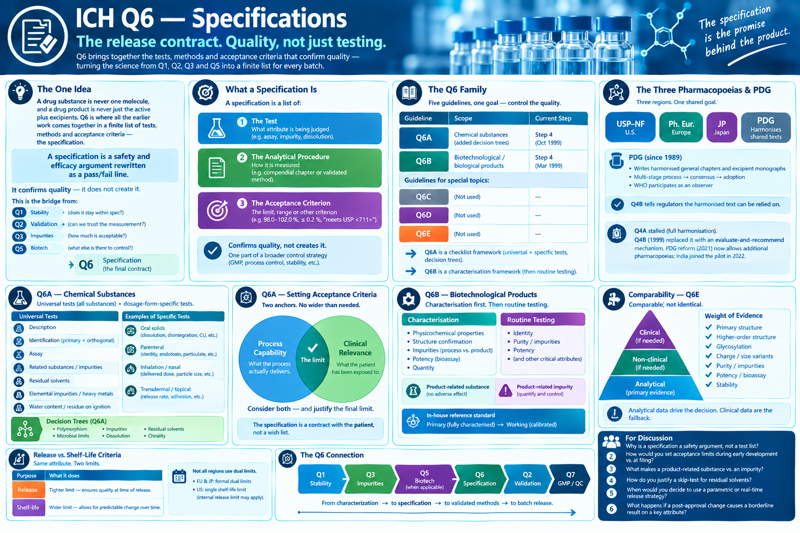
(The graphic is a lecture aid, not a citation — its “Q6C / Q6D / Q6E (Not used)” rows and its “Comparability — Q6E” panel don’t match the current ICH text: there is no Q6C/D/E, and product comparability lives in Q5E. The Q6 family is Q6A plus Q6B, as described below.)
The one idea
By the time a molecule reaches this page, the science has been done. Q1 established how it degrades and how long it lasts. Q3 worked out which impurities matter and at what level. Q5 — for a biologic — characterised the protein and its heterogeneity. Q2 showed the methods can be trusted. Q6 is where all of that collapses into a finite list.
A specification is the short document a quality-control lab actually runs against every batch: a handful of tests, each with a numerical limit, and a single verdict at the end — release, or reject. Everything the development programme learned has to survive being compressed into that list, because the list is what the patient’s supply is checked against, batch after batch, for the life of the product.
A specification is a safety and efficacy argument rewritten as a pass/fail line — and someone signs their name under the result.
This sits alongside the sections before it:
Q1 asks: does the product remain within its specification over time?
Q2 asks: can we trust the analytical evidence used to answer that?
Q3 asks: of everything that is not the drug, how much is acceptable — and on what basis?
Q6 asks: of all the quality attributes we could measure, which ones go on the list, which tests measure them, and where exactly does each limit sit?
What a specification is
Q6A and Q6B share one definition:
A specification is a list of tests, references to analytical procedures, and appropriate acceptance criteria — numerical limits, ranges, or other criteria for the tests described — which establishes the set of criteria to which a drug substance or drug product should conform to be considered acceptable for its intended use.
Three parts, and all three matter:
| Part | What it fixes |
|---|---|
| The test | What attribute is being judged — assay, a named impurity, dissolution, sterility |
| The analytical procedure | How it is measured — usually by pointing to a validated in-house method or a pharmacopoeial chapter, so the number is reproducible |
| The acceptance criterion | The limit — 98.0–102.0 %, ≤ 0.2 %, “meets USP <711>” — the line between pass and fail |
Two framing points run through the whole guideline:
- A specification confirms quality; it does not create it. Quality is built in by development and by GMP; end-product testing verifies it. A specification is deliberately not exhaustive — it does not re-measure everything that was characterised, only the attributes that need routine confirmation.
- It is one element of a total control strategy. In-process controls, process validation, raw-material controls, a stability programme, and GMP all carry part of the assurance. The specification is the final, documented checkpoint — not the sole guarantee.
The Q6 family
Q6 is split by the kind of product, because a synthetic molecule and a protein made in cells need different test lists:
| Guideline | Scope | Current step |
|---|---|---|
| Q6A | Specifications: Test Procedures and Acceptance Criteria for New Drug Substances and New Drug Products — Chemical Substances — universal and dosage-form-specific tests, plus a set of decision trees | Step 4, October 1999 |
| Q6B | Specifications: Test Procedures and Acceptance Criteria for Biotechnological / Biological Products — characterisation, product-related substances vs. impurities, potency, reference standards | Step 4, March 1999 |
There is no Q6C. Antibiotics, herbals, and radiopharmaceuticals are outside both; biosimilars lean on Q6B via the Q5E comparability logic. The mental model: Q6A is a checklist framework — here are the tests, here are the trees for the hard calls; Q6B is a characterisation framework — first describe the molecule completely, then decide which small subset to test every time.
The challenge: specifications evolve with knowledge
The same difficulty that shadows Q1, Q2 and Q3 lands squarely on Q6. A specification is not written once. It tightens as the evidence base grows, moving from a wide, provisional net early in development to a precise, well-justified contract by the time of filing — and it keeps being revised afterwards.
The driver is uncertainty. Early on you have a handful of batches, methods that are still changing, and a safety picture built largely from animal data and historical knowledge of the chemical class. You cannot justify a tight limit, so you set a wide one and lean on characterisation instead of routine testing. As clinical and laboratory characterisation accumulates, the safety profile sharpens, the methods get more precise and robust, the impurity profile is understood across many batches, and formal stability data replace projections — and the specification narrows to match.
| Stage | Batches & data | Specification | Analytical emphasis |
|---|---|---|---|
| Discovery / early development | Few batches; safety from animal data and prior knowledge of the class | Few tests, wide limits, several attributes “report result” rather than pass/fail | Heavy characterisation; methods qualified, not fully validated |
| Phase 1–3 | Growing clinical exposure; batch history building | Limits tighten as the clinical and laboratory safety profile is understood; physicochemical attributes reviewed; stability and compatibility knowledge improves | Methods move toward validation; specificity and stability-indicating power established |
| Filing / commercial | Many batches; a real impurity-profile history; formal Q1 stability studies | More tests, tighter, fully justified limits; effective routine controls; release vs. shelf-life criteria set | Robust, validated methods — improved precision and accuracy; efficient enough for routine QC |
| Post-approval (Phase 4) | Hundreds of commercial batches | Interim limits confirmed or tightened; skip testing / RTRT introduced where data support it | Method lifecycle management; trending |
A specification is a running summary of how well the product is understood. Wide limits are a confession of uncertainty; tight, defended limits are the evidence that the uncertainty has been retired.
Because the earliest commercial specification is still a first draft written with limited evidence, many acceptance criteria are filed as interim — set conservatively, flagged for revision once enough commercial data accumulate — and changing a limit afterwards is a regulated post-approval change (Q12 governs how much room the original filing leaves for that). Throughout, the discipline Q6 demands is the same one Q1 and Q2 demand: fixed tests, fixed methods, fixed reporting, so that batch 400 can be compared honestly against batch 4.
The anatomy of a specification
Q6A organises tests into universal (apply to essentially every substance or product) and specific (depend on the molecule and the dosage form).
Universal tests:
| Drug substance | Drug product |
|---|---|
| Description — physical state, colour | Description — appearance of the dosage form |
| Identification — must be specific (IR, or two orthogonal methods; not a single non-specific test) | Identification |
| Assay — a specific, stability-indicating method for content | Assay — content of the active |
| Impurities — organic, inorganic, residual solvents (Q3) | Degradation products (not process impurities — those are controlled in the substance) |
Specific tests — a sample, by dosage form:
| Dosage form | Typical added tests |
|---|---|
| Solid oral | Dissolution, disintegration, hardness/friability, uniformity of dosage units, water content, microbial limits, polymorphic form (if performance-relevant), particle size |
| Parenteral | Sterility, bacterial endotoxins / pyrogens, particulate matter, pH, osmolality, extractable volume, reconstitution time, closure integrity |
| Inhalation / nasal | Delivered-dose uniformity, aerodynamic particle-size distribution, spray pattern, leak rate |
| Transdermal / topical | Drug release rate, adhesion, cohesion (cold flow), microbial limits |
Some attributes are characterised but not put on the specification — measured during development, and only added to routine testing if they can vary in manufacture or storage and affect safety or performance (polymorphic form and particle size are the classic examples, resolved by decision tree).
Q6A — small-molecule specifications
Beyond the test lists, Q6A’s real contribution is a set of decision trees for the judgement calls that a checklist cannot make. In brief, they cover:
- Polymorphism — does the drug substance have polymorphs; can they interconvert in manufacture or on the shelf; do they change bioavailability or stability? Only if all three, does a solid-state form test belong on the specification.
- Drug-substance impurities and drug-product degradation products — how to convert the Q3 thresholds and the batch history into a specified-impurity limit, an any-unspecified-impurity limit, and a total.
- Residual solvents — Option 1 / Option 2 limits from Q3C, and when a routine test is needed versus a supplier statement.
- Microbiological quality — when a non-sterile product needs microbial-limit testing on the specification versus periodic testing.
- Dissolution — single-point vs. profile; when disintegration is an acceptable surrogate for a rapidly dissolving immediate-release product; how to build a profile acceptance criterion for modified-release.
- Chirality — identity and impurity control for a single-enantiomer drug.
Q6A also introduces three concepts that recur across the course:
- Periodic (skip) testing — running a test on a pre-selected fraction of batches or at set intervals rather than every batch, when a large body of data shows the attribute is reliably in control (residual solvents, microbial limits, and particle size are common candidates). A failure sends you back to batch-by-batch testing.
- Parametric release — for a terminally sterilised product, releasing on the validated sterilisation-cycle data (F₀, temperature, pressure, time, load) instead of the finished-product sterility test, whose statistics are weak anyway.
- Release vs. shelf-life acceptance criteria — see below.
Setting an acceptance criterion — capability vs. relevance
This is the concept to fix for graduate students. Every limit on a specification is pulled between two anchors:
| Anchor | The question it asks | If it alone set the limit |
|---|---|---|
| Process capability | What range does this attribute actually occupy across our batches (mean ± a few standard deviations)? | Limits track what the process happens to do — they can be tighter than safety requires, and they penalise normal variation |
| Clinical / toxicological relevance | What range was present in the batches used in the pivotal safety and efficacy studies — what has the patient actually been exposed to? | Limits reflect what is safe and effective — but may be far wider than the process needs, letting a drifting process go unnoticed |
Q6A’s answer: an acceptance criterion should be no wider than the clinical and stability experience supports, and normally set with reference to what the process can reliably deliver. A limit much wider than the batch data is a red flag (why so much slack?); a limit much tighter than the clinical experience needs is a self-inflicted supply risk. Justifying each number against both anchors — with the batch-analysis table, the stability data, the tox and clinical batch history, and the pharmacopoeial standard — is the core of the specification section of a filing.
Q6B — biological product specifications
For a biologic the test list cannot be written until the molecule has been characterised, because the “drug substance” is a population of related species, not one structure. Q6B separates two activities:
- Characterisation — an extensive, largely one-time (or infrequent) analytical exercise establishing the physicochemical, structural, immunochemical, and biological-activity profile of the product.
- Routine specification testing — a deliberately smaller subset, run on every batch, chosen because it is the sensitive indicator of a process staying in its validated state.
Q6B groups the analytical work into categories:
| Category | Examples |
|---|---|
| Physicochemical properties | Molecular mass, isoform / charge-variant pattern, extinction coefficient, electrophoretic and chromatographic patterns, spectroscopic profile |
| Structure confirmation | Amino-acid sequence and composition, terminal sequences, peptide map, sulfhydryls and disulfide bridges, carbohydrate structure and glycan profile |
| Impurities | Process-related (host-cell protein, host-cell DNA, media components, downstream reagents, leached Protein A) and product-related (aggregates, fragments/clips, deamidated, oxidised, and other modified forms) |
| Potency | A quantitative measure of biological function, in units against a reference standard — mandatory, and a physicochemical assay is not a substitute |
| Quantity | Protein content |
Two Q6B-specific ideas:
- Product-related substance vs. product-related impurity. A molecular variant that has been shown to have no adverse effect on safety or efficacy is a substance — part of the product, not a defect. A variant that is not so demonstrated is an impurity, with a limit. The distinction is an analytical + biological judgement, revisited as knowledge grows.
- The in-house reference standard. There is usually no compendial standard for a novel biologic, so the manufacturer establishes a primary reference standard (fully characterised, from a clinically qualified lot) and calibrates successive working standards against it. Every potency and many purity results are expressed relative to that material, so its qualification and its replacement over time are critical-path activities.
Release vs. shelf-life acceptance criteria
For a drug product, the same attribute can carry two limits: a tighter one applied at release and a wider one that must hold throughout shelf life. The gap allows for known, predictable change on storage — a small assay decline, a rise in a degradation product, a dissolution slowdown — so that a batch released near its shelf-life limit would fail before expiry.
The concept is only partly harmonised: it is used in the EU and Japan as formal dual limits, while the US treats the tighter figure as an internal (in-house) release limit and registers the single shelf-life specification. A filing has to be built for the target region’s convention.
Periodic testing, parametric release, and real-time release
Q6 opens the door — and Q8, Q13 and Q14 push it wider — to release decisions that lean less on end-product testing:
- Periodic / skip testing reduces the frequency of a test that data show is always in control.
- Parametric release replaces the sterility test with sterilisation-cycle evidence.
- Real-time release testing (RTRT) replaces an end-product test with a validated in-process measurement plus a process model — e.g. NIR-based content uniformity on a tablet press, or a dissolution prediction from granule and press data. The specification still lists the attribute and its acceptance criterion; what changes is where and when the measurement is made.
In every case the acceptance criterion on the specification does not go away — the burden of proof simply moves upstream, and the Q2 / Q14 validation of the surrogate measurement has to be correspondingly stronger.
The certificate of analysis — the specification, one batch at a time
A specification is generic to the product. The certificate of analysis (CoA) is the specification applied to a single batch — the industry-standard document that travels with the material and says, for lot number X, exactly what was tested, what the limits were, and what the batch actually gave.
A CoA lays the same information side by side, one row per test:
| Column | What it carries | Where it comes from |
|---|---|---|
| Analytical test | The attribute and the method reference | Methods developed and validated under Q2; stability-indicating power from Q1; impurity methods from Q3 |
| Specification | The acceptance criterion — the numerical limit or range | The approved Q6 specification |
| Result | The measured value for this batch | The QC lab’s data for that lot |
| Justification / basis | The pharmacopoeial reference, the internal method number, the regulatory filing section that each limit rests on | The registration dossier |
The CoA summarises years of development into a single page. Everything behind it — the method validation, the stability programme, the impurity qualification, the acceptance-criteria justification — is compressed into “test / limit / result / pass”. It is what a purchaser of an API checks on receipt, what a regulator asks for during an inspection, and what a qualified person signs against before releasing a product batch.
The teaching point: if you have a current CoA that conforms, you have documented evidence that the control measures for that product are working for that lot. A batch is not “good because it was made carefully” — it is releasable because a CoA shows it met every line of the specification, using methods and limits that are themselves justified. The CoA is where the abstract control strategy becomes a concrete, signed release decision.
A small-molecule API certificate
For a synthetic drug substance the CoA is a compact, recognisable list. Representative tests and illustrative limits (real numbers are drug- and dose-specific):
| Test | Method | Acceptance criterion | Example result |
|---|---|---|---|
| Description | Visual | White to off-white powder | Conforms |
| Identification A | IR (ATR-FTIR) | Concordant with reference standard | Conforms |
| Identification B | HPLC retention time (vs. standard) | RT matches reference standard | Conforms |
| Assay (anhydrous, solvent-free) | HPLC (or NIR / UV-Vis) | 98.0–102.0 % | 99.6 % |
| Related substances | HPLC | Any unspecified ≤ 0.10 %; each specified ≤ its qualified limit; total ≤ 1.0 % | Largest unspecified 0.04 %; total 0.3 % |
| Specific optical rotation | Polarimetry | +18.0° to +22.0° | +20.4° |
| Chiral purity | Chiral HPLC or CE | Undesired enantiomer ≤ 0.5 % | 0.1 % |
| Water content | Karl Fischer (or loss on drying) | ≤ 0.5 % | 0.2 % |
| Residual solvents | Headspace GC | Meets Q3C (e.g. methanol ≤ 3000 ppm, THF ≤ 720 ppm) | Conforms |
| Elemental impurities / heavy metals | ICP-MS | Meets Q3D (e.g. Pd within PDE) | Conforms |
| Residue on ignition (sulfated ash) | Ph. Eur. / USP <281> | ≤ 0.1 % | 0.05 % |
Two points the table teaches:
- Two identity tests — “two engines on an aeroplane.” Regulators require identity to be specific, and one orthogonal method (IR and an HPLC/UV/TLC/optical-rotation confirmation) will satisfy that. Running a second is cheap insurance against a mislabelled drum or a method-specific artefact: you only strictly need one, but you fly with two.
- Impurity limits are a moving target. A rough teaching benchmark — it varies widely with drug and daily dose, and is looser than the Q3 thresholds a typical oral dose would demand — is: any single unspecified impurity well under ~1 % (in practice near the Q3 identification threshold); specified, qualified impurities allowed higher, roughly 1–3 % with toxicological justification; a drug substance running > 3 % total impurities generally not acceptable for clinical use. All three tighten sharply from Phase 1 to filing as batches accumulate and methods improve.
An immediate-release tablet certificate
The drug-product CoA keeps the universal tests (description, identity, assay, degradation products) and adds dosage-form performance tests:
| Test | Method | Acceptance criterion | Example result |
|---|---|---|---|
| Description | Visual | White, round, biconvex, debossed “X” | Conforms |
| Identification (×2) | HPLC RT + UV spectrum (or TLC / IR / optical rotation) | Concordant with reference standard | Conforms |
| Assay | HPLC (or NIR, UV/Vis) | 95.0–105.0 % of label claim | 99.1 % |
| Degradation products | HPLC | Each specified ≤ limit; any unspecified ≤ ID threshold; total ≤ 1.0 % | Total 0.4 % |
| Chiral purity | Chiral HPLC or CE | Undesired enantiomer ≤ 1.0 % | 0.2 % |
| Dissolution (or drug release) | USP <711>, Apparatus 2 | ≥ 80 % (Q) dissolved in 30 min | 94 % at 30 min |
| Uniformity of dosage units | USP <905> (content uniformity) | Acceptance value ≤ 15.0; each unit 90–110 % of label claim | AV 3.8 |
| Water content | Karl Fischer | ≤ 3.0 % | 1.4 % |
| Hardness / friability / disintegration | Compendial | Friability ≤ 1.0 %; disintegration ≤ 15 min (in-process or on the CoA) | Conforms |
| Microbial limits | USP <61>/<62> | Meets criteria for non-sterile oral solids | Conforms |
Consistency of the dosage form is the point of the uniformity and dissolution tests: every tablet a patient takes should deliver essentially the same dose (the 90–110 % per-unit expectation), and release it at essentially the same rate.
Large molecules and advanced therapies
Every product class needs its own CoA, and the further from a small molecule you go, the more the certificate changes shape.
A monoclonal antibody CoA replaces the small-molecule rows with: appearance; identity by peptide map and charge profile (icIEF); protein content (A280); purity by SEC (monomer / high- and low-molecular-weight species), CE-SDS, and icIEF charge variants; a released-glycan profile; potency by a cell-based bioassay (reported as % of the reference standard); process impurities — host-cell protein (ELISA), residual host-cell DNA (qPCR), leached Protein A; endotoxin and sterility; polysorbate content; pH and osmolality. There is no single “assay” and no single “impurities” number — each is a family of orthogonal methods (Q5, Q6B).
An autologous CAR-T CoA is different again, and the differences are instructive:
| Attribute | Typical CAR-T test | Why it is there |
|---|---|---|
| Identity | Flow cytometry: CD3⁺ T cells; anti-CAR staining (or vector qPCR) | Confirm the product is T cells expressing the intended CAR |
| Cell dose / strength | Viable CAR-positive T cells per kg (flow + viability dye, e.g. 7-AAD) | The dose is a count of living engineered cells, not a mass |
| Viability | Flow (7-AAD / AO-PI) | ≥ ~70 % — cells are the product and they are fragile |
| Potency | IFN-γ release or cytotoxicity on target-antigen cells | Functional kill activity; a phenotype alone is not potency |
| Transduction efficiency | Flow (% CAR⁺) | How much of the dose is actually engineered |
| Vector copy number | qPCR | ≤ ~5 copies/cell — insertional-oncogenesis risk control |
| Replication-competent lentivirus/retrovirus | Culture / PCR | Must be not detected — a safety gate |
| Residual process materials | Anti-CD3/CD28 bead count; residual cytokines (IL-2) | Manufacturing reagents that must be cleared |
| Sterility / mycoplasma / endotoxin | Rapid methods + compendial (14-day) sterility | Safety — but see below |
Three structural constraints shape that certificate:
- The batch is one patient. An autologous dose is a batch of one; there is no “three registration batches” and little classical characterisation history, so the specification leans heavily on platform and prior knowledge and on process control.
- The shelf life can be hours. A fresh CAR-T product may expire the day it is made (cryopreserved products buy time), so the CoA has to be completed on a compressed timeline.
- Some results read out after dosing. The 14-day compendial sterility test cannot gate a product with a 48-hour shelf life. Release runs on rapid sterility, Gram stain, and endotoxin, with the full test as confirmatory — a formal conditional / exceptional release framework, with a plan for what happens if the confirmatory test later fails.
How the pieces fit — the specification as the meeting point
Q6 is where the other quality guidelines converge into a single document:
Q1 — stability data fix the shelf-life limits for assay, degradation products, dissolution, water
↓
Q3 — the threshold ladder and batch history fix the specified-impurity, unspecified-impurity, and total-impurity limits
↓
Q5 / Q6B — characterisation fixes the identity, purity, and potency tests for a biologic, and which variants are substances vs. impurities
↓
Q4 — harmonised general chapters supply the standard test methods the specification cites
↓
Q6 — assemble and justify the acceptance criteria: universal tests + specific tests, each limit defended against process capability and clinical relevance
↓
Q2 — validate every listed method at the limit it has to police
↓
Q7 / QC — run the specification on every batch and record it on the certificate of analysis; that document is the release decision
What Q6 demands of the analytical method
A limit is only real if a method can defend it:
- The method must discriminate at the acceptance criterion. A ≤ 0.2 % impurity limit needs a method whose quantitation limit sits below 0.2 % and whose precision at that level is known — the direct link to Q2.
- Identity tests must be specific. A single non-specific test (one retention time, one colour reaction) is not acceptable for identity; Q6A expects orthogonality, and Q6B often needs a peptide map or an immunoassay.
- The method and the limit are set together. A round-number acceptance criterion the method cannot reproduce at that edge is a specification that will generate out-of-specification investigations from method noise alone.
- Pharmacopoeial methods still need verification in your lab, on your matrix (USP
<1226>) — citing a chapter is not the same as demonstrating it works for your product.
Where the analyst sits
Writing a specification is a sequence of judgement calls that no template makes for you: is this impurity specified or caught by the unspecified limit; is that charge variant a substance or an impurity; should particle size be on the specification or only characterised; is a 98.0–102.0 % assay limit justified by the batch data or just a habit; does this product need release and shelf-life criteria for the region we are filing in; is the process mature enough to move this test to skip testing. Each answer has to be defensible to a regulator years later, against data that did not exist when the limit was set. That is the A in STEAM again — the science produces the numbers; the analyst decides which ones become promises.
If the Q1 lesson is a shelf life is a hypothesis that must survive testing, the Q2 lesson is a measurement is a claim that must earn our trust, and the Q3 lesson is an impurity limit is a safety argument in the form of a number, the Q6 lesson is: a specification is the finite, numbered promise that everything the science established is still true of this batch — and the analyst is the one who has to be able to defend every line of it.
For discussion
- An impurity is present at 0.08 %, 0.10 %, and 0.09 % in your three registration batches. The Q3 qualification threshold is 0.15 %. Where do you set the acceptance criterion, and how do you justify it against both anchors — process capability and clinical relevance?
- A Phase 1 specification lists an impurity limit of “≤ 0.5 % (report result)”; the commercial specification for the same impurity is “≤ 0.15 %”. Explain what changed between those two documents to justify the tighter limit — and what would have been wrong with filing 0.15 % at Phase 1.
- You receive a drug-substance lot from a supplier with a certificate of analysis showing every result within specification. What does the CoA let you conclude, what does it not tell you, and what would you still verify before using the material?
- Your assay method has a precision (RSD) of 1.5 % at the 100 % level. Marketing wants a 98.0–102.0 % release limit. What is the statistical problem, and what limit would you defend instead?
- A drug product loses about 3 % of its assay value over its 24-month shelf life. The lower shelf-life limit is 95.0 %. What should the release limit be, and how does the answer differ for an EU filing versus a US filing?
- A polymorph screen finds two forms of the drug substance. Walk the Q6A polymorphism decision tree: what would put a solid-state form test on the drug-product specification, and what would keep it off?
- For a monoclonal antibody, deamidation at one site rises from 5 % to 12 % after a media change but a comparability study shows no effect on binding, potency, or PK. Is the deamidated form now a product-related substance or an impurity? What decides it?
- Your site has 300 batches of clean residual-solvent data. Make the case for moving that test to periodic (skip) testing — and describe exactly what happens if a skip-tested batch fails.
- A tablet line proposes NIR-based real-time release for content uniformity, dropping the end-product test. What stays on the specification, what moves, and why does the method validation burden go up?
- A regulator asks why your biologic’s potency is reported as “percent of reference standard” rather than in absolute units. What is your answer, and what does it imply about maintaining that reference standard over the product’s life?
Source note. ICH Q6A Specification: Test Procedures and Acceptance Criteria for New Drug Substances and New Drug Products: Chemical Substances reached Step 4 on 6 October 1999, including its attached decision trees. ICH Q6B Specifications: Test Procedures and Acceptance Criteria for Biotechnological/Biological Products reached Step 4 on 10 March 1999. The two are read with Q3A/Q3B/Q3C/Q3D (impurity limits), Q1 (shelf-life criteria), Q2 (method validation), Q5 (biotech characterisation and comparability), and the compendial general chapters harmonised under Q4B. Real-time release testing and the lifecycle management of specifications are developed further in Q8–Q12, Q13, and Q14. (Instructor: Q6A and Q6B date from 1999 and have not been revised; confirm the current decision-tree numbering and check whether the ICH work plan has opened a Q6 revision before lecture, and cross-check all threshold references against the current Q3 texts.)