ICH Q8–Q12 — Development, Risk, Quality System & Lifecycle
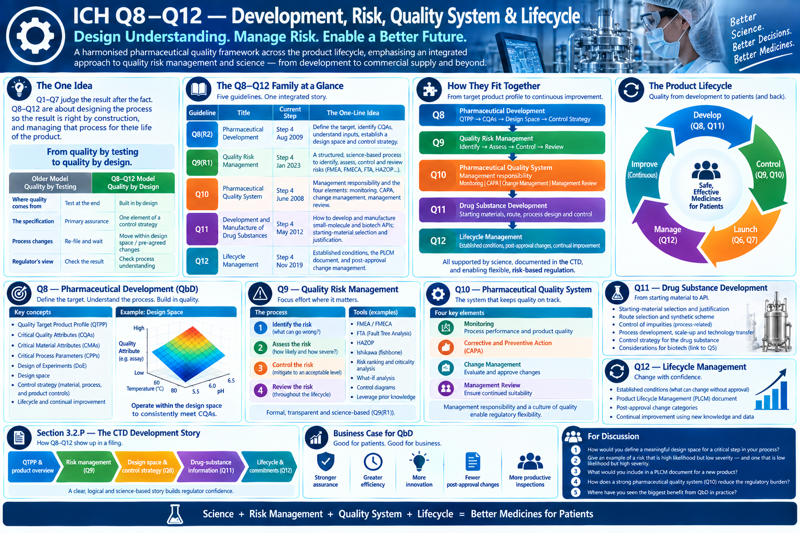
The one idea
Everything before this section judges a result after the fact: is the shelf life real (Q1), can the measurement be trusted (Q2), is the impurity safe (Q3), is the limit defensible (Q6), is the system that produced it under control (Q7). Q8–Q12 are about designing the process so the result is right by construction, and then managing that process for the life of the product.
A harmonised pharmaceutical quality framework applicable across the life cycle of the product, emphasising an integrated approach to quality risk management and science.
These are the newer ICH guidelines, and they read differently from Q1–Q7. They are high-level and deliberately less prescriptive — visionary rather than procedural — and they trade fixed rules for flexible, risk-based regulatory approaches: do the science, understand your process, show your reasoning, and the filing (and the inspection, and the post-approval change process) can be lighter in proportion.
| Older model — quality by testing | Q8–Q12 model — quality by design | |
|---|---|---|
| Where quality comes from | Inspected in at the end — test the batch, release or reject | Built in by design — the process is understood well enough that a conforming batch is the expected outcome |
| The specification | The primary assurance of quality | One element of a control strategy that also includes material controls, process controls, and in-process monitoring |
| Process changes | Re-file and wait | Move within an approved design space, or use pre-agreed change protocols |
| The regulator’s view | Check the result against the limit | Check whether the applicant understands the relationship between inputs and the result |
What this page covers
- Q8 — pharmaceutical development: quality by design (QbD), the quality target product profile, critical quality attributes (CQAs), design space, and control strategy — plus the methods used to determine a design space and build causality from process parameters to quality attributes.
- Q9(R1) — quality risk management: the process, the toolbox (FMEA, FMECA, FTA, HAZOP…), and criticality analysis as the way a high-dimensional process is reduced to “what matters”; the R1 revision on formality and subjectivity.
- Q10 — the pharmaceutical quality system: management responsibility, the four elements (monitoring, CAPA, change management, management review), and how it enables regulatory flexibility.
- Q11 — development and manufacture of drug substances (small molecule and biotech); starting-material selection and justification.
- Q12 — lifecycle management: established conditions, the Product Lifecycle Management (PLCM) document, and post-approval change categories.
- How a pharmaceutical development section is assembled into the CTD — risk management, design space, control strategy, drug-substance information.
- The analytical throughline: CQAs drive specifications drive methods; a method is part of the control strategy, and changing it is a managed change under Q10/Q12 — the same logic Q14 applies to the method itself.
The family at a glance
| Guideline | Title | Current step | The one-line idea |
|---|---|---|---|
| Q8(R2) | Pharmaceutical Development | Step 4, Aug 2009 | Define the target, identify the CQAs, understand how inputs affect them, and describe the resulting design space and control strategy |
| Q9(R1) | Quality Risk Management | Step 4, Jan 2023 | A structured, science-based process for identifying, evaluating, controlling, and reviewing risks to quality — with a toolbox and two guiding principles |
| Q10 | Pharmaceutical Quality System | Step 4, Jun 2008 | One quality system spanning the whole lifecycle, built on GMP + ISO + Q8/Q9, with four elements and active management ownership |
| Q11 | Development and Manufacture of Drug Substances | Step 4, May 2012 | Q8/Q9/Q10 thinking applied to the API, with detailed guidance on selecting and justifying the starting material |
| Q12 | Technical and Regulatory Considerations for Pharmaceutical Product Lifecycle Management | Step 4, Nov 2019 | The tools to make post-approval changes efficiently — established conditions, the PLCM document, change-management protocols |
A labelling note. Q11 is Development and Manufacture of Drug Substances; Q12 is Lifecycle Management. It is a common slip to swap them or to call Q11 “continuous validation” — that concept belongs to the FDA’s process-validation lifecycle and to Q13, not to a numbered Q11 title.
Q8 — pharmaceutical development and quality by design
Q8 asks the applicant to begin with the end in mind and then show the reasoning that connects the two ends:
- Quality Target Product Profile (QTPP) — a prospective summary of the quality characteristics the product must have to deliver the intended clinical performance (dosage form, route, dose, pharmacokinetic profile, container, shelf life).
- Critical Quality Attributes (CQAs) — the physical, chemical, biological, or microbiological properties that must be within a limit to ensure the QTPP is met (assay, uniformity, dissolution, a named impurity, aggregation for a protein).
- Link inputs to CQAs — identify which material attributes (of drug substance, excipients) and process parameters affect each CQA, and how strongly, using risk assessment plus experimentation.
- Design space — the multidimensional combination of input ranges that has been demonstrated to assure quality. Working within it is not a change; leaving it is.
- Control strategy — the planned set of controls, derived from that understanding, that keeps the process producing conforming product.
- Continual improvement — within the pharmaceutical quality system (Q10), across the lifecycle.
The vocabulary
| Term | Definition |
|---|---|
| QTPP | Prospective summary of the quality characteristics needed for the desired clinical performance |
| CQA | An attribute that must stay within a limit to ensure product quality |
| CMA | Critical material attribute — a property of an input material that affects a CQA |
| CPP | Critical process parameter — a parameter whose variability affects a CQA and must therefore be controlled |
| Design space | The demonstrated combination of input variables and parameter ranges that provides assurance of quality |
| PAR / NOR | Proven acceptable range / normal operating range — the licensed and the day-to-day parameter windows |
| Control strategy | The full set of controls — input material, process, in-process, and finished-product — derived from product and process understanding |
Determining the design space
A design space is a claim about causality between parameters and attributes, and Q8 recognises several ways to earn that claim. Any one, or any combination, may be used.
| Method | What it is | When it earns its place |
|---|---|---|
| First-principles approach | Combining experimental data with mechanistic knowledge of chemistry, physics, and engineering to model and predict performance | Desirable but not required or expected in every case; strongest where the mechanism is genuinely understood (heat/mass transfer, reaction kinetics, crystallisation) |
| Statistically designed experiments (DOE) | An efficient, structured way to determine the effect of multiple parameters and their interactions in a minimum of runs | The workhorse — it is how causality gets built into the parameter–attribute relationships rather than assumed |
| Scale-up correlations | A semi-empirical approach that translates operating conditions between scales or between pieces of equipment | When lab or pilot data must be projected to commercial scale and a dimensionless-group or engineering correlation supports the translation |
| FMECA (Failure Mode, Effects and Criticality Analysis) | A structured risk analysis that identifies which process parameters, if they fail or drift, affect which CQAs — and how severely | To define the critical process parameters related to the critical quality attributes before committing experimental effort, and to focus the DOE on the parameters that matter |
The practical sequence is usually: FMECA to narrow the field → DOE (and, where possible, mechanistic models) to quantify the relationships → scale-up correlations to move the result to commercial equipment. The output is a design space plus a control strategy, both filed for the licence to manufacture and sell.
Criticality analysis — FMECA
A commercial process has dozens of parameters and dozens of measurable attributes. Criticality analysis is the discipline of reducing the dimensionality of a complex system to what matters.
- It is a systematic way to separate the parameters that move a CQA from the parameters that do not.
- It enables focus — effort, monitoring, and the metrics used to track and control the process are spent on what is actually necessary.
- Done well, it builds causality into the process parameters that are tied to quality attributes, rather than carrying every parameter forward “just in case”.
| Step | FMEA | FMECA adds |
|---|---|---|
| Identify failure modes | For each parameter/step, how could it go wrong? | — |
| Rate | Severity of effect on the CQA, Occurrence (likelihood), Detection (chance of catching it) | — |
| Prioritise | Risk Priority Number (S × O × D), or a severity/occurrence matrix | An explicit criticality ranking that foregrounds severity of the patient impact, not just the arithmetic product |
| Act | Mitigate the high-priority modes; feed them into the control strategy | Formally designates the CPPs related to each CQA |
Where the field is going. Today, criticality is still largely tacit knowledge and experience — an expert panel scoring a spreadsheet. The direction of travel is toward explicit, statistical, model-driven criticality assessments built from data: the DOE and the mechanistic model produce the sensitivity coefficients, and the criticality ranking falls out of them rather than out of a workshop vote.
The control strategy
The control strategy is what a design space is for. Q8 defines it as the planned set of controls, derived from current product and process understanding, that assures process performance and product quality. It is assembled from the development work:
- DOEs establish which parameters and attributes are important, and the ranges over which the process behaves.
- Process parameters and quality attributes are enumerated and their relationships mapped.
- FMECA relates the process parameters to the quality attributes and, through them, to patient risk.
- The CPPs and CQAs are defined — the short list that must be controlled and measured every batch.
- The result is the framework for the control strategy and for the filing that supports the licence to manufacture and sell.
A control strategy typically spans: controls on input material attributes (drug substance, excipients, container); controls on process parameters (setpoints and ranges for the CPPs); in-process controls and in-process tests; a monitoring scheme; and the finished-product specification (Q6). The more assurance sits upstream in material and process controls, the less has to rest on end-product testing — up to and including real-time release testing (Q13, Q6).
Writing it into the CTD
Pharmaceutical development and the related information are submitted in the Common Technical Document — Module 3 is Quality, and the pharmaceutical development section (3.2.P.2 for the product, with parallel drug-substance content) is organised around the QbD outputs:
| Section | Content |
|---|---|
| Quality risk management and product/process development | The QTPP, the CQA identification and its rationale, the risk assessments, and the development studies (including DOE) that link material attributes and process parameters to the CQAs |
| Design space | The description of the multivariate design space, how it was determined, how it was verified, and how it relates to the scale and equipment of commercial manufacture |
| Control strategy | The full control strategy — input, process, in-process, and finished-product controls — and the justification for each element |
| Drug-substance–related information | The drug substance CQAs and the aspects of its manufacture and control that affect the drug product (the Q11 content) |
This is all in scope of Q8 (with its Annex on the enhanced approach); Q11 and Q12 extend it to the drug substance and to the post-approval phase.
Q9 — quality risk management
Q9 supplies the method that Q8, Q10, Q11, and Q12 all lean on. Two principles:
- The evaluation of risk to quality should be based on scientific knowledge and ultimately link to protection of the patient.
- The level of effort, formality, and documentation of the risk-management process should be commensurate with the level of risk.
The process is a loop: risk assessment (identification → analysis → evaluation) → risk control (reduction / acceptance) → risk communication → risk review. The toolbox includes FMEA, FMECA, fault tree analysis (FTA), HACCP, HAZOP, preliminary hazard analysis (PHA), and simple risk-ranking and filtering.
Q9(R1) (2023) revised the guideline to address four points where practice had drifted: high subjectivity in risk scoring; unclear expectations around formality (not every decision needs a full FMECA); the role of QRM in ensuring supply continuity, not just product quality; and better guidance on risk-based decision-making. It connects directly to the risk-based stringency in Q7 and to how acceptance criteria are justified in Q6.
Q10 — the pharmaceutical quality system
Q10 describes one quality system covering the entire product lifecycle — pharmaceutical development, technology transfer, commercial manufacturing, and product discontinuation — built on regional GMP and complementing ISO quality-management concepts. It is what operationalises Q8 and Q9 in a company.
Management responsibility is explicit: senior management owns the quality system, defines the quality policy and objectives, provides resources, and conducts management review.
Four elements run at every lifecycle stage:
| Element | What it does |
|---|---|
| Process performance and product quality monitoring | A system to detect variability, keep the process in a state of control, and identify improvement opportunities |
| Corrective and preventive action (CAPA) | Structured investigation and action, from complaints, deviations, recalls, audits, and trends |
| Change management | Evaluate, approve, and implement changes to products and processes using Q9 risk assessment and current knowledge |
| Management review | Periodic review by management of quality-system performance and of the actions arising |
Two enablers cut across all four: knowledge management and quality risk management. A mature, demonstrable PQS is the basis on which regulators grant the operational and regulatory flexibility that Q8 and Q12 promise.
Q11 — development and manufacture of drug substances
Q11 applies the Q8/Q9/Q10 approach to the active substance, for both chemical entities and biotechnological/biological products, and can be followed with a traditional approach, an enhanced approach, or a combination.
Its most-cited contribution is the selection and justification of starting materials. General principles include:
- A starting material is incorporated as a significant structural fragment into the drug substance (the same phrase that governs where GMP begins in Q7).
- Manufacturing steps that affect the drug substance impurity profile should normally be part of the described process — you cannot push the GMP boundary so far downstream that impurity-forming and impurity-purging chemistry sits outside it.
- The applicant should identify the CQAs of the starting material and the risks it carries into the drug substance, and justify the proposed control strategy for the drug substance on that basis.
It ties tightly to Q3A/Q3C/Q3D (impurity origin, fate, and purge), to Q7 (GMP for the described steps), and to Q6 (the drug-substance specification that results).
Q12 — lifecycle management
Q8–Q11 describe how to develop and register a product. Q12 addresses what Q8–Q11 largely left implicit: how to change a registered product efficiently. Without it, a design space is only as useful as a regulator’s willingness to honour it, and every method tweak or site move becomes a submission.
| Tool | What it does |
|---|---|
| Established Conditions (ECs) | The legally binding elements of the dossier that assure product quality — and, by exclusion, the elements a manufacturer can change under its own Q10 system without prior approval. Defining ECs narrowly (with justification) is the mechanism for operational flexibility |
| PLCM document | The Product Lifecycle Management document — a summary in the dossier that gathers the ECs, their reporting categories, any post-approval change protocols, and the control strategy, so the lifecycle plan is visible in one place |
| Post-Approval Change Management Protocol (PACMP) | A protocol agreed with the regulator in advance describing a future change, the studies that will support it, and the acceptance criteria — so the eventual change is reported at a lower category |
| Structured approaches / product lifecycle management | Frameworks for managing CMC changes, including for established products, and for the interplay between regulatory assessment and inspection |
Regional caveat. Q12 reached Step 4 in 2019, but adoption is uneven — notably, the FDA has stated that the Established Conditions and PLCM concepts are not fully compatible with the current US legal framework and are being implemented only in part. Confirm the current regional position before relying on ECs in a filing strategy.
The analytical throughline
Q8–Q12 are usually taught as manufacturing guidelines, but the analyst is inside every step:
- A CQA is only actionable if a method can measure it at the limit that matters — the link straight back to Q2 and Q6.
- The DOEs that populate a design space are analytical exercises: the response variables are assay, impurity levels, dissolution, particle size, aggregation — measured by methods whose own precision sets the resolution of the design space.
- The FMECA that ranks process parameters against CQAs and patient risk is only as good as the analytical data behind the severity and detectability scores.
- An analytical method is part of the control strategy. Changing it — a new column chemistry, a move from HPLC to a PAT model — is a managed change under Q10 and, depending on how the ECs were defined, under Q12.
- Q14 is Q8 applied to the method itself: the analytical target profile is the method’s QTPP, the method operable design region is its design space, and the method lifecycle is managed exactly like the process lifecycle here.
Why QbD?
The enhanced approach is optional and front-loads cost. The case for doing it anyway:
- Higher assurance of product quality — a process understood well enough to predict its output, not just test it.
- Cost saving and efficiency for industry and regulators — fewer investigations, fewer failed batches, less duplicated review.
- Facilitates innovation to address unmet medical needs — the framework rewards new technology instead of penalising it.
- More efficient manufacturing — fewer rejects, less rework, better yield.
- Fewer compliance actions — minimised or eliminated exposure to costly penalties and recalls.
- Better odds of first-cycle approval — a coherent development story is easier to review.
- Streamlined post-approval changes — move within the design space; use PACMPs and ECs (Q12) instead of a submission per change.
- More focused inspections — pre-approval inspection (PAI) and post-approval GMP inspection target the genuine risks the applicant has already identified.
- Continual improvement — an approved design space and a mature Q10 system make ongoing optimisation a normal activity rather than a regulatory event.
The honest counterpoint: the enhanced approach demands significant early investment in DOE, modelling, and analytical development; the regulatory reward is real but uneven across regions; and a poorly constructed design space can lock a process into commitments that are hard to unwind. QbD is a decision, not a default.
Where the analyst sits
Q1, Q2, Q3, and Q6 tell you what the numbers must mean. Q7 tells you why anyone believes them. Q8–Q12 are where the analyst helps decide which numbers the process will be built around — running the DOEs that map parameters to CQAs, owning the methods that make each CQA measurable at the limit that matters, supplying the data that a criticality analysis turns into a control strategy, and then living inside the change-management system that governs every method for the rest of the product’s life.
If the Q1 lesson is a shelf life is a hypothesis, the Q2 lesson is a measurement is a claim that must earn trust, the Q6 lesson is a specification is a numbered promise, and the Q7 lesson is none of those promises count unless the system is under control, the Q8–Q12 lesson is: quality is designed, not inspected — and the design is a documented chain of causality from process parameters to quality attributes to the patient, which someone has to build and defend. That is the A in STEAM again: the analyst is where an abstract control strategy becomes a set of real measurements.
For discussion
- A team has a list of 40 process parameters and 12 CQAs. Walk through how you would get from that to a design space and a control strategy — what does FMECA do first, what does DOE do next, and where do scale-up correlations come in?
- Q8 says a first-principles model is “desirable but not required or expected in every case.” When is a mechanistic model worth building, and when is a well-designed DOE enough on its own?
- An operating point moves from the normal operating range to another point that is still inside the approved design space. Is that a change that needs to be reported? What if it moves just outside the design space?
- Your FMECA scores a parameter low on severity but the DOE later shows it has a large, interacting effect on a CQA. What went wrong in the risk assessment, and what does Q9(R1) say about that kind of subjectivity?
- Distinguish “critical process parameter” from “critical material attribute” from “critical quality attribute” with one concrete example of each for an immediate-release tablet.
- Under Q12, an analyst wants to replace an HPLC assay with an equivalent UPLC method. Whether that needs prior approval depends on how the “established conditions” were written. Explain the two possible outcomes.
- Give the business case for QbD to a manufacturing director who sees only the upfront DOE and modelling cost. Which of the benefits are near-term and which only pay off years later?
- Q11 says steps that affect the impurity profile should normally be inside the described process. Why can’t a company simply designate a late intermediate as the “starting material” to shorten the regulated portion of the route?
Source note. ICH Q8(R2) Pharmaceutical Development reached Step 4 in August 2009 (R2 adding the Annex on the enhanced approach). ICH Q9(R1) Quality Risk Management reached Step 4 on 18 January 2023 (original Q9, November 2005). ICH Q10 Pharmaceutical Quality System reached Step 4 on 4 June 2008. ICH Q11 Development and Manufacture of Drug Substances reached Step 4 on 1 May 2012, with a Q&A on starting-material selection adopted in 2017. ICH Q12 Technical and Regulatory Considerations for Pharmaceutical Product Lifecycle Management reached Step 4 on 20 November 2019, with annexes. These five are read alongside Q7 (GMP), Q6 (specifications and real-time release), Q3 (impurity origin and control), and the modernisation pair Q13 and Q14. (Instructor: confirm the current Step 4 dates and any open ICH work-plan revisions before lecture; check the current FDA position on Q12 Established Conditions and the PLCM document, which as of the last revision was only partially adopted in the US; and note for students that Q11 is “development and manufacture of drug substances,” not “continuous validation,” and that Q12 — not Q11 — is the lifecycle-management guideline. The overview graphic is a lecture aid, not a citation: its lifecycle wheel pairs the guidelines loosely with lifecycle stages (e.g. “Launch — Q6, Q7”), which is a teaching simplification rather than anything in the ICH text.)