How an API Is Made — Synthesis and Scale-Up
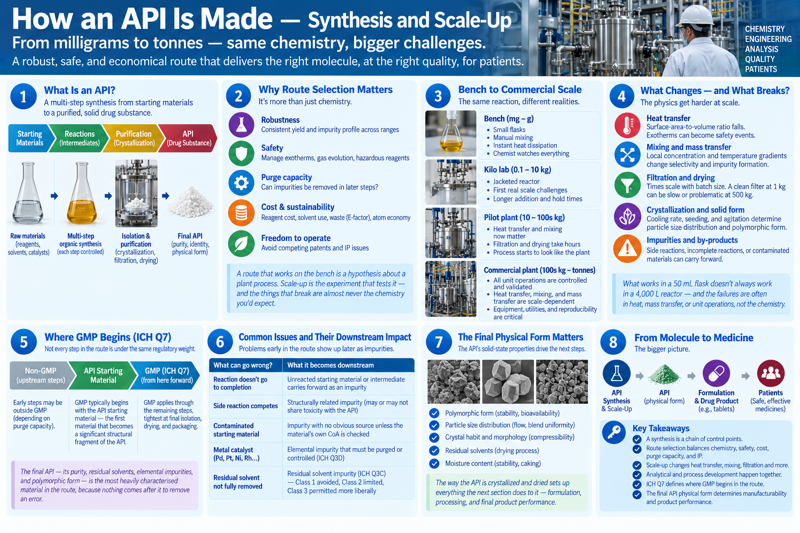
Before there is a tablet, there is a molecule, and before there is a molecule at commercial scale, someone has to have proven — repeatedly, at increasing scale — that the same reaction that worked in a 50 mL flask still works in a 4,000 L reactor. That proof is process research and scale-up, and it is where most of an API’s eventual impurity profile and physical form get decided.
The one idea
A route that works on the bench is a hypothesis about a plant process. Scale-up is the experiment that tests it — and the things that break are almost never the chemistry you’d expect.
A synthesis is a chain of control points
An API is built from starting materials through a defined sequence of reactions, each producing an isolable intermediate, until the final step delivers the API itself — usually followed by a purification (crystallization, sometimes chromatography) that fixes its final form. Every step is a place where things can go right or wrong:
| What can go wrong at a step | What it becomes downstream |
|---|---|
| Reaction doesn’t go to completion | Unreacted starting material or intermediate carries forward as an impurity |
| A side reaction competes | A structurally related impurity, sometimes sharing the API’s toxicity, sometimes not |
| A contaminated or off-spec starting material | An impurity with no obvious source unless the material’s own CoA is checked |
| A metal catalyst (Pd, Pt, Ni, Rh…) | An elemental impurity that has to be purged or controlled — the direct link to ICH Q3D testing, the week atomic spectroscopy is taught |
| Residual reaction solvent not fully removed | A residual solvent impurity (ICH Q3C), classed by toxicity (Class 1 avoided, Class 2 limited, Class 3 permitted more liberally) |
None of this is visible in the finished white powder. It is found — or missed — by the analytical methods built around the route, which is why route chemistry and analytical method development happen together, not in sequence.
Choosing a route is not just chemistry
Process research doesn’t take the first route that works; it evaluates candidate routes against criteria that have nothing to do with whether the reaction is elegant:
- Robustness — does the yield and impurity profile hold up across the ranges of temperature, concentration, and reagent quality a plant will actually see, or does it need bench-level precision?
- Safety — exotherms, gas evolution, unstable intermediates, reagents that are fine in a fume hood and dangerous in a jacketed reactor holding hundreds of litres.
- Purge capacity — can later steps (crystallizations especially) reliably wash an impurity out, so an early imperfection doesn’t have to be perfect?
- Cost, atom economy, and green chemistry — solvent volumes, reagent cost, waste generated per kilogram of API, and increasingly a formal E-factor target.
- Freedom to operate — does the route avoid a competitor’s process patent?
A route redesigned late in development to fix one of these is common, and every redesign reopens the impurity and degradation picture — which is exactly the “moving target” that makes a systematic, comparable analytical program non-negotiable across route changes.
Bench → kilo lab → pilot plant → commercial plant
The same reaction run at four scales is not the same experiment, because the physics around the chemistry changes with vessel size in ways the flask never revealed:
| Scale | Typical batch | What’s now different |
|---|---|---|
| Bench | mg – g | Fast manual mixing, instant heat dissipation, chemist watches every addition |
| Kilo lab | 0.1 – 10 kg | First real jacketed reactor, first agitator design, first taste of longer addition and hold times |
| Pilot plant | 10 – 100s kg | Heat transfer and mixing efficiency now scale-dependent, not assumed; filtration and drying take hours, not minutes |
| Commercial plant | 100s kg – tonnes | Every unit operation (charge, react, quench, extract, crystallize, filter, dry) is now a controlled, validated process step |
Why scale-up breaks things that bench chemistry never revealed:
- Surface-area-to-volume ratio falls as vessels get bigger, so heat that dissipated instantly in a flask now has to be removed through a jacket — an exotherm that was a non-event on the bench can become a runaway or a safety incident in a reactor.
- Mixing and mass transfer get harder, not easier — a reagent added over seconds by hand goes in over hours through a dip pipe, so local concentration and temperature gradients appear that a flask never had, changing selectivity and impurity formation.
- Filtration and drying times scale with cake depth and batch size, not linearly with batch mass — a crystallization that filters cleanly at 1 kg can be impractically slow, or dry unevenly, at 500 kg.
- Crystallization control becomes the whole ballgame for the API’s final physical form — cooling rate, seeding, and agitation at scale determine particle size distribution and polymorphic form, both of which the next section inherits directly: they decide whether the API even flows and compresses well enough for direct compression, or whether it needs granulating first.
Where GMP begins in the route
Not every step in the synthesis is manufactured under the same regulatory weight. ICH Q7 draws a line at the API starting material — the raw material or intermediate that becomes a significant structural fragment of the API — and GMP applies from that point forward, tightening as the route approaches the final isolation. The logic is purge capacity again: an error early in the route can still be removed by a later purification step; an error in the final crystallization, drying, or micronization reaches the patient with nothing left to catch it. This is also why the final isolated API — its purity, its residual solvents, its elemental impurities, its polymorphic form — is the single most heavily analytically characterised material in the whole route.
Where the analyst sits
The chemist who ran the route on the bench is rarely the person defending it in a regulatory filing five years later at commercial scale. The record that survives — validation batches, in-process specifications, impurity qualification data — has to speak for a process that changed as it scaled. Reading that record and asking does this impurity limit still make sense given how the route actually runs today is analytical judgment, not chemistry.
For discussion
- A palladium-catalysed coupling step is three steps before the final API isolation. Why might the elemental-impurity risk still be considered high, even with two purifications in between?
- A crystallization that gave a single, reproducible polymorph at kilo-lab scale gives a mixture of two polymorphs at pilot-plant scale, with no change to the recipe on paper. What changed, and how would you find out?
- Process research chooses a lower-yielding route because it avoids a Class 1 residual solvent entirely. Was that the right trade, and what would change your answer?
Source note. Route selection and scale-up follow standard process-chemistry texts (Anderson, Practical Process Research & Development) and the Q3C residual-solvent classes. GMP scope follows ICH Q7. (Instructor: add a specific worked route once course examples are finalised.)