From Powder to Tablet — Solid-Dosage Manufacturing
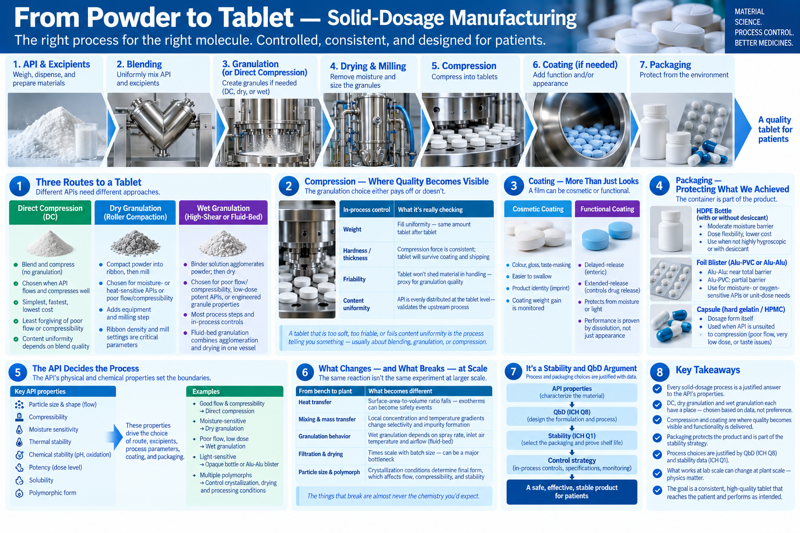
The previous section ended with the API’s final physical form — particle size, flow, compressibility, moisture sensitivity — decided by how it was crystallised and isolated. Everything in this section is downstream of that: the API’s own properties decide which manufacturing route is even available, before a single formulation decision is made.
The one idea
Every solid-dosage process is a justified answer to one question: given what this API actually is — how it flows, how it compresses, what degrades it — what is the least-handling route to a tablet that still meets its specification, batch after batch?
Three routes to a tablet, in order of how much they touch the powder
| Route | What happens | When it’s chosen | What it costs you |
|---|---|---|---|
| Direct compression (DC) | API and excipients blended, then compressed straight into tablets — no intermediate agglomeration step | The API already flows and compresses well at the required dose; the simplest, cheapest, fastest route | Least forgiving of a poorly flowing or poorly compressible API; content uniformity is entirely dependent on blend quality |
| Dry granulation (roller compaction) | Powder is compacted into a ribbon between rollers, then milled into granules | API is moisture- or heat-sensitive, or doesn’t flow/compress well enough for DC, but can’t tolerate wet processing | Adds equipment and a milling step; ribbon density and mill settings become new critical parameters |
| Wet granulation (high-shear or fluid-bed) | A binder solution or suspension agglomerates the powder into granules, which are then dried | Poor flow or compressibility, low-dose potent APIs that need better content uniformity, or where granule properties must be engineered | Adds a drying step (moisture must come back out); the most process steps, the most in-process controls, the most that can go wrong |
Fluid-bed granulation is the wet route worth naming specifically: the powder bed is fluidised in a stream of air while binder solution is sprayed in, and the granules are dried in the same vessel without transferring the batch — one piece of equipment doing agglomeration and drying together, which reduces handling but makes airflow, spray rate, and inlet-air temperature the parameters that decide whether the granule comes out right.
Compression and the properties it exposes
Whichever route produced the material — powder blend or granules — it is compressed into tablets, and compression is where the granulation choice either pays off or doesn’t:
| In-process control | What it’s really checking |
|---|---|
| Weight | Fill uniformity — is the die filling the same amount, tablet after tablet? |
| Hardness / thickness | Compression force is consistent, and the tablet will survive coating and shipping |
| Friability | The tablet won’t shed material in handling — a proxy for how well the granulation held together |
| Content uniformity | The API is evenly distributed at the tablet level, not just the blend level — the test that ultimately validates the whole upstream route |
A tablet that is too soft or too friable is usually a granulation problem revealing itself late; a tablet with poor content uniformity is usually a blending or flow problem revealing itself even later still. Compression is the first point any of this becomes visible as a number.
Coating — cosmetic, or a control
A film applied to the compressed tablet does one of two different jobs:
- Cosmetic / taste-masking — colour, gloss, ease of swallowing, identity (colour and imprint) for the patient and pharmacist. Coating weight gain is tracked, but performance isn’t riding on it.
- Functional coating — delayed-release (enteric, survives the stomach) or extended-release (controls the rate the drug is available at all). Here the coating is the mechanism, and dissolution becomes the test that decides whether the product works, not just whether it looks right.
Packaging — protecting what the process just achieved
Everything upstream — the API’s stability, the tablet’s moisture sensitivity, whether the coating is intact — is only as good as the container that ships it:
| Packaging | Typical protection | Chosen when |
|---|---|---|
| HDPE bottle (with or without desiccant) | Moderate moisture barrier, dose flexibility, lower cost | The API is not highly hygroscopic or photosensitive, or a desiccant closes the gap |
| Foil blister (Alu-PVC or Alu-Alu) | Alu-Alu is close to a total moisture/oxygen barrier; Alu-PVC is a partial one | Alu-Alu for genuinely moisture- or oxygen-sensitive APIs; Alu-PVC where the risk is lower and unit-dose presentation still matters |
| Capsule (hard gelatin / HPMC) | The dosage form itself, packaged in bottle or blister | The API is unsuited to compression at all — poor compressibility, very low dose needing a carrier, or a taste that tableting can’t mask |
The justification is a stability and QbD argument, not a preference
None of the choices above are made on convenience. Each is defended with data and traced back to a control strategy:
- The route (DC vs. dry vs. wet granulation) is justified by the API’s measured flow, compressibility, and moisture/heat sensitivity — a quality-by-design argument under Q8: the process is designed around the material’s known properties so that a conforming batch is the expected outcome, not a hoped-for one.
- The packaging is justified directly by stability data under ICH Q1 — a hygroscopic API that shows significant change in an open-dish humidity study earns an Alu-Alu blister or a desiccant bottle; a photosensitive one earns an opaque bottle or overwrap, backed by Q1B photostability data.
- Container-closure integrity is itself a tested attribute, not an assumption — it is part of what the stability program is confirming batch after batch, on the shelf, for the life of the product.
Put together, the manufacturing route and the pack are two halves of one answer to the same question this week’s risk-management framework asks of everything it touches: what could go wrong with this specific molecule, and what does the process or the pack have to do about it?
Where the analyst sits
None of the choices above are visible in a finished tablet by inspection. A tablet made by direct compression and one made by wet granulation can look identical and perform very differently under stress — which is exactly why the in-process controls in the tables above exist, and why a batch record reader needs to know which control is protecting against which upstream decision.
For discussion
- A roller-compacted formulation and a wet-granulated formulation both meet release specifications for the same product. What stability or robustness question would you still want answered before picking one for commercial launch?
- An API is reformulated from a bottle with desiccant to an Alu-Alu blister after a stability failure. What does that change tell you about the API, and what data would have predicted it before the failure?
- A functional (extended-release) coating passes every appearance and weight-gain check, but the batch still fails dissolution. Where would you look first?
Source note. Solid-dosage unit operations follow standard pharmaceutical-technology texts (Aulton, Pharmaceutics: The Design and Manufacture of Medicines). QbD justification follows ICH Q8; packaging justification follows ICH Q1.