ICH Q1 — Stability Testing
A deep dive into the ICH Q1 family: forced degradation, storage conditions, significant change, climatic zones, reduced designs, data evaluation, and the modernized Q1 revision — and where the analyst sits in all of it.
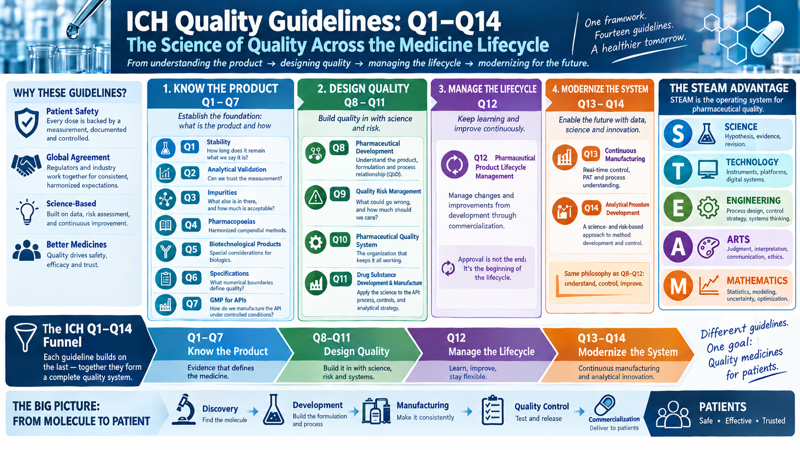
Section 1 established that analysis is science. Section 2 put that science inside a company that has to discover, develop, and sell a medicine. This section is the third step of the funnel — regs — and the through-line is simple: an analytical result that can’t be defended to a regulator doesn’t ship a product.
What ICH is — the International Council for Harmonisation of Technical Requirements for Pharmaceuticals for Human Use; who its members and observers are; why harmonisation exists (one dataset, multiple markets).
The Quality (“Q”) guidelines that touch analysis directly get a page each — Q1 is a full write-up; the rest are outlines for now. They’re listed below and in the left menu:
<1000> are requirements, <1000>-and-above are informational.<1226>).Every choice you defended on scientific grounds in Sections 1–2 now has to survive a second audience: an inspector reading your data cold, years later, deciding whether patients can trust it.
A deep dive into the ICH Q1 family: forced degradation, storage conditions, significant change, climatic zones, reduced designs, data evaluation, and the modernized Q1 revision — and where the analyst sits in all of it.
Q2(R2): the performance characteristics a method must demonstrate before it can be trusted to make release and stability decisions.
The Q3 family: organic impurities in the drug substance (Q3A) and product (Q3B), residual solvents (Q3C), and elemental impurities (Q3D) — reporting, identification, and qualification thresholds.
Q6A and Q6B: how acceptance criteria and the associated tests are chosen for small-molecule and biological products — the document that turns science into a pass/fail line.
Q7: what good manufacturing practice means for the QC laboratory — controls, documentation, OOS handling, stability, and reference standards.
The QbD and lifecycle family: pharmaceutical development (Q8), quality risk management (Q9), the pharmaceutical quality system (Q10), development and manufacture of drug substance (Q11), and lifecycle management (Q12) — treated as one story.
Q13: continuous manufacturing of drug substances and products — control strategy, real-time release testing, and the analytical shift from batch pulls to in-line measurement.
Q14: analytical quality by design — the analytical target profile, method operable design region, robustness, and the method lifecycle that Q2(R2) validation now confirms rather than initiates.