ICH Q4 — Pharmacopoeial Harmonisation
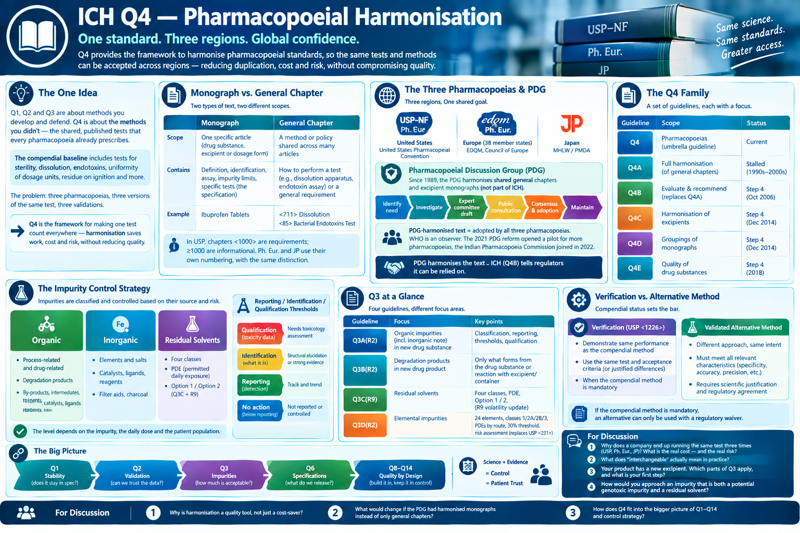
(The graphic is a lecture aid, not a citation — its “Q4C / Q4D / Q4E” rows and some panel labels don’t match the current ICH text; the Q4 family is Q4B plus its fourteen annexes, as described below.)
The one idea
Q1, Q2 and Q3 are about methods you develop and defend. Q4 is about the methods you didn’t — the shared, published tests that every pharmacopoeia already prescribes for sterility, dissolution, endotoxins, uniformity of dosage units, residue on ignition, and dozens more. These are the compendial baseline: a company does not re-invent a sterility test, it runs the one in the book.
The problem Q4 addresses is that there is more than one book.
The USP sterility test, the Ph. Eur. sterility test, and the JP sterility test all measure the same thing. If they are written differently, a manufacturer selling in all three regions may have to run the test three times — three protocols, three validations, three sets of records — for no gain in product quality.
Q4 is the framework for making one test count everywhere. Its lesson: harmonisation is a quality tool — it removes duplicated work that adds cost and risk without adding assurance.
What a pharmacopoeia is
A pharmacopoeia is a legally recognised compendium of standards for medicines: what a substance or product must be, and the tests that demonstrate it. In a filing, citing a pharmacopoeial standard means you are held to that text as published, including its future revisions.
Two kinds of text, and the distinction runs through the rest of this page:
| Monograph | General chapter | |
|---|---|---|
| Scope | One specific article — a named drug substance, excipient, or dosage form | A method or policy shared across many articles |
| Contains | Definition, identification, assay, impurity limits, specific tests — the specification for that article | How to perform a test (dissolution apparatus, endotoxin assay), or a general requirement |
| Example | Ibuprofen Tablets | <711> Dissolution, <85> Bacterial Endotoxins Test |
In USP, the chapter number signals enforceability: chapters numbered below <1000> are requirements; <1000> and above are informational. Ph. Eur. and JP use their own numbering but draw the same line between mandatory methods and guidance.
Q4 is overwhelmingly about general chapters — the shared methods — because that is where harmonisation is both feasible and valuable. Monographs are article-by-article and largely left to the individual pharmacopoeias.
The three pharmacopoeias and the PDG
The ICH regions are served by three pharmacopoeias:
| Region | Publisher | |
|---|---|---|
| USP–NF | United States | United States Pharmacopeial Convention |
| Ph. Eur. | Europe (38 member states) | EDQM, Council of Europe |
| JP | Japan | MHLW / PMDA |
Since 1989 these three have coordinated through the Pharmacopoeial Discussion Group (PDG) — a body separate from ICH whose job is to write harmonised versions of shared general chapters and excipient monographs. The PDG works a topic through a multi-stage process (identification → investigation → expert-committee draft → public consultation → consensus → regional adoption → ongoing maintenance), and a text is “PDG-harmonised” only when all three pharmacopoeias have adopted substantively the same wording. WHO participates as an observer. A PDG reform, published in 2021, opened a pilot to admit further pharmacopoeias; the Indian Pharmacopoeia Commission joined that pilot from 2022.
PDG harmonises the text. ICH’s role (Q4B) is to tell regulators the harmonised text can be relied on. Those are two different jobs done by two different bodies.
The Q4 family
| Guideline | Scope | Status |
|---|---|---|
| Q4 | Pharmacopoeias — the umbrella topic | Framework only |
| Q4A | Pharmacopoeial harmonisation — the original ambition of a single harmonised text set | Not pursued as an ICH guideline; the work sits with the PDG |
| Q4B | Evaluation and recommendation of pharmacopoeial texts for use in the ICH regions | Core guideline Step 4, November 2007 |
| Q4B Annexes 1–14 | One PDG-harmonised general chapter each, evaluated and recommended by the Q4B Expert Working Group | Step 4, 2009–2013 |
Q4A — why “one text” stalled
The tidy end-state would be a single harmonised pharmacopoeial text adopted verbatim by every region. In practice that runs into:
- Legal standing. Each pharmacopoeia is embedded in its own region’s law. A pharmacopoeia cannot simply cede authorship of a legally binding standard to an external group.
- Format and general-notices differences. Reagents, reference standards, rounding rules, and the “general notices” that govern how every monograph is read differ between compendia; a chapter that is word-identical can still behave differently inside its parent book.
- Revision cycles. The three pharmacopoeias publish on different schedules, so even a jointly agreed text drifts out of alignment over time unless actively maintained.
So ICH did not produce a Q4A guideline. Instead it accepted that the PDG would keep harmonising texts as far as practical, and built Q4B to get regulatory value out of that work without requiring perfect textual identity.
Q4B — evaluate and recommend
Q4B set up an Expert Working Group with members from the three regulatory authorities and the three pharmacopoeias. Its process, per harmonised general chapter:
- The PDG declares a general chapter harmonised (Stage 5/6 of its process).
- The Q4B EWG evaluates that text: are the three pharmacopoeial versions technically equivalent for regulatory purposes? Where do real differences remain?
- The EWG issues an annex with a formal outcome — typically that the texts are interchangeable, so a manufacturer may use any one of the three and it will be accepted by regulators in all three ICH regions.
- The annex records region-specific conditions: passages that are not harmonised, additional local requirements, or parts of the chapter the recommendation does not cover.
“Interchangeable” is the payoff: run the Ph. Eur. dissolution chapter, cite it in a US or Japanese submission, and it is accepted — you do not re-run it to USP <711>. But interchangeable is not “identical.” Ph. Eur. marks non-harmonised passages with black diamonds (♦…♦); USP uses a similar convention. The Q4B annex is where you learn which parts of a chapter you can actually rely on across regions and which still carry a regional tail.
The Q4B annexes
Each annex is one general chapter. The fourteen:
| Annex | General chapter |
|---|---|
| 1 | Residue on Ignition / Sulphated Ash |
| 2 | Test for Extractable Volume of Parenteral Preparations |
| 3 | Test for Particulate Contamination: Sub-visible Particles |
| 4A | Microbiological Examination of Non-Sterile Products: Microbial Enumeration Tests |
| 4B | Microbiological Examination of Non-Sterile Products: Tests for Specified Micro-organisms |
| 4C | Microbiological Examination of Non-Sterile Products: Acceptance Criteria |
| 5 | Disintegration Test |
| 6 | Uniformity of Dosage Units |
| 7 | Dissolution Test |
| 8 | Sterility Test |
| 9 | Tablet Friability |
| 10 | Polyacrylamide Gel Electrophoresis |
| 11 | Capillary Electrophoresis |
| 12 | Analytical Sieving |
| 13 | Bulk Density and Tapped Density of Powders |
| 14 | Bacterial Endotoxins Test |
The pattern is clear: these are workhorse release and characterisation tests — the ones almost every solid oral, parenteral, or biologic filing has to include. Harmonising them removes duplicated method work from nearly every dossier. Note what is absent: chromatographic assay methods, spectroscopy, and anything close to a specific molecule — those stay in monographs, where harmonisation is far harder and the ICH quality guidelines (Q2, Q3, Q6) do the heavy lifting instead.
The compendial-method obligations for the analyst
Q4 is where “a method in the book” meets “a method in your lab.” Three rules govern that hand-off.
1. Verification, not validation, for a compendial method. A pharmacopoeial method is already validated by the pharmacopoeia. When you adopt one, you do not re-run a full Q2 package — you verify it works in your hands, with your product matrix, on your instruments. USP <1226> Verification of Compendial Procedures frames this: assess the subset of Q2 characteristics that could plausibly fail on transfer — usually specificity against your impurities and excipients, and precision — and document it. Verification is lighter than validation precisely because someone else already did the validation.
2. A validated alternative is allowed — but the compendial method wins ties. You may use an alternative (often faster, or better suited to your matrix) provided you demonstrate equivalence to the compendial method. The catch: in a dispute, the pharmacopoeial method is the referee. If your rapid microbiological method and the <71> sterility test disagree, the compendial result stands. So an alternative method needs a validation package and an equivalence argument, and you still have to be able to run the compendial method.
3. Sometimes the compendial method is mandatory. Where a monograph or a regulation names a specific test as the standard — many endotoxin, sterility, and elemental-impurity requirements — that method is not optional and an alternative needs regulatory agreement, not just internal equivalence data. This is how Q3 reaches the bench: Q3C and Q3D set the limits, and USP <467> (residual solvents) and <232>/<233> (elemental impurities) are the compendial procedures that enforce them.
Harmonisation status — a moving target
The same caution that shadows Q1 and Q3 applies here: the compendial landscape moves.
- The PDG reform (2021) restructured the harmonisation process and opened membership; the outcome of the expansion pilot is still settling.
- ICH has signalled that the Q4B mechanism will not be extended to new general chapters — the reformed PDG process, with regulators engaged earlier, is expected to carry harmonisation forward, and the fourteen existing annexes remain in force.
- Individual chapters are revised on their own cycles; a chapter that was harmonised can partly de-harmonise when one pharmacopoeia updates ahead of the others.
The practical consequence for a filing written today: check the current Q4B annex and the current version of each cited general chapter in all target regions, rather than assuming “harmonised” is permanent.
(Status as of early 2026 — confirm the PDG reform outcome and the Q4B forward plan against current ICH/PDG communications before lecture.)
How it fits the control strategy
Q4 is the layer that supplies the shared methods the rest of the framework assumes:
PDG — harmonise the general chapters (sterility, dissolution, endotoxins, uniformity …)
↓
Q4B — recommend the harmonised text as interchangeable across the ICH regions, with the regional caveats documented
↓
Q6 — the specification cites those chapters as the tests behind its acceptance criteria
↓
Q2 / USP <1226> — verify each adopted compendial method performs in your lab with your product
↓
Q7 / QC — run it, batch after batch, as part of the release decision
Where the analyst sits
Compendial methods can look like the boring part of the job — you follow the book. But the judgment calls are real: does this harmonised dissolution chapter’s non-harmonised apparatus footnote matter for my product in this region? Is my faster endotoxin method genuinely equivalent, or only equivalent on the batches I happened to test? Did the last Ph. Eur. supplement change a chapter I cite, and does my US filing still line up? The pharmacopoeia gives you the method; deciding whether it fits, whether an alternative is defensible, and whether your version still matches the current text across three regions is analytical work.
If the Q1 lesson is a shelf life is a hypothesis that must survive testing, and the Q2 lesson is a measurement is a claim that must earn our trust, the Q4 lesson is: a standard is only useful if everyone reads it the same way — and harmonisation is the unglamorous work of making that true.
For discussion
- A harmonised general chapter is “interchangeable” under a Q4B annex, but the annex lists a region-specific acceptance criterion for one ICH region. You run the test once. Have you met the requirement everywhere? What do you check?
- Your site wants to replace the compendial
<71>sterility test with a rapid microbiological method. What does Q4 / compendial practice require before you can, and what must you still be able to do afterwards? - You adopt the PDG-harmonised Uniformity of Dosage Units chapter. Which Q2 characteristics would you include in the USP
<1226>verification, and which would you skip — and why? - Why did ICH build Q4B (evaluate and recommend) instead of pursuing Q4A (one identical text)? Give two concrete obstacles to a single text.
- A Ph. Eur. supplement revises the dissolution chapter; USP has not yet followed. A product is filed in both regions citing “the harmonised chapter.” What is the problem, and what are your options?
- Residual-solvent limits come from Q3C but the test on the bench is USP
<467>. Explain the division of labour between the ICH guideline and the pharmacopoeial chapter. - When is running the compendial method non-negotiable, even if you have a validated alternative that performs better on your matrix?
Source note. ICH Q4B Evaluation and Recommendation of Pharmacopoeial Texts for Use in the ICH Regions reached Step 4 on 1 November 2007; its fourteen annexes reached Step 4 between 2009 and 2013 and remain in force. Q4A was never issued as an ICH guideline — pharmacopoeial harmonisation is carried out by the Pharmacopoeial Discussion Group (USP, Ph. Eur., JP; established 1989), whose 2021 reform and membership-expansion pilot (Indian Pharmacopoeia Commission from 2022) are ongoing. Compendial-method practice for the analyst: USP <1226> Verification of Compendial Procedures, the General Notices provisions on alternative methods and the compendial method as the method of record, and the chapters that implement other ICH guidelines — USP <467> (residual solvents, Q3C), <232>/<233> (elemental impurities, Q3D). (Instructor: confirm the PDG reform outcome, the current status of the Q4B forward plan, and the present version of any cited general chapter before lecture — the pharmacopoeias revise on independent cycles.)