ICH Q5 — Quality of Biotechnological Products
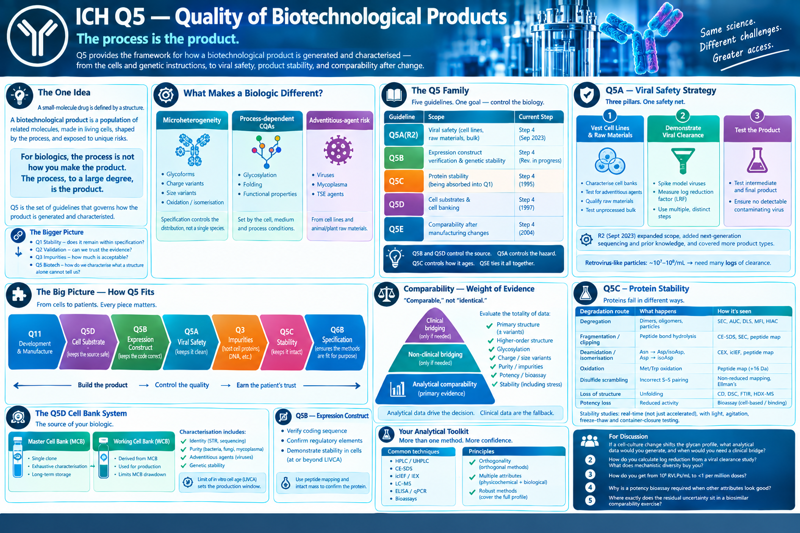
The one idea
A small-molecule drug substance is defined by a structure: draw the molecule, and any competent lab anywhere can make the same thing and prove it is the same thing. A biotechnological product — a monoclonal antibody, a therapeutic enzyme, a fusion protein, a vaccine antigen — is not like that. It is assembled by living cells, folded and decorated by cellular machinery, and purified out of a broth that also contains the cells’ own proteins, DNA, and — potentially — viruses. Change the cell line, the medium, the bioreactor, the purification train, or the formulation, and you can change the product itself in ways no structural drawing captures.
For a biologic, the process is not how you make the product. The process, to a large degree, is the product.
The Q5 family is the set of guidelines that governs the parts of that reality analysis has to police: what the product is made in, whether the genetic instructions stayed intact, whether the process removes viruses, how the protein ages, and — the question that ties it all together — whether the thing coming out of the new process is still the same medicine as the thing that was tested in patients.
This sits alongside the three sections before it:
Q1 asks: does the product remain within its specification over time?
Q2 asks: can we trust the analytical evidence used to answer that?
Q3 asks: of everything that is not the drug, how much is acceptable — and on what basis?
Q5 asks: when the drug is a protein made in cells, what do we have to characterise and control that a structure alone would never tell us?
What makes a biologic different
Three properties drive everything in Q5:
- Microheterogeneity. A “pure” protein drug substance is a population of closely related molecules — the intended sequence plus a distribution of glycoforms, charge variants (deamidation, C-terminal lysine, N-terminal pyroglutamate), size variants (aggregates, fragments/clips), and oxidised or isomerised residues. The specification controls the distribution, not a single species.
- Process-dependent quality attributes. Glycosylation is the clearest case: the glycan pattern is set by the host cell and the culture conditions, and it can govern half-life, effector function (ADCC/CDC), and immunogenicity. It is a critical quality attribute that the chemistry does not predict and the process determines.
- Adventitious-agent risk. Because the product is grown in mammalian (or insect, or microbial) cells and fed animal- or plant-derived raw materials, there is a contamination pathway — viruses, mycoplasma, TSE agents — that simply does not exist for a molecule made by organic synthesis.
Everything in the Q5 set is a response to one of these three.
The Q5 family
Q5 is not one document. It is five, each carving out one piece of “how the product is generated”:
| Guideline | Scope | Current step |
|---|---|---|
| Q5A(R2) | Viral safety evaluation of products derived from cell lines of human or animal origin — cell-substrate testing, viral clearance, bulk testing | Step 4, Sep 2023 (R2 — expanded scope) |
| Q5B | Analysis of the expression construct — verify the coding sequence and confirm it is retained through production | Step 4, 1995 (revision under way) |
| Q5C | Stability testing of biotechnological / biological products — the protein-specific companion to Q1 | Step 4, 1995 (being subsumed into the modernised Q1) |
| Q5D | Derivation and characterisation of cell substrates — cell banking, identity, freedom from adventitious agents, cell-substrate stability | Step 4, 1997 |
| Q5E | Comparability of a product before and after a manufacturing change | Step 4, 2004 |
The mental model: Q5B and Q5D control the source (the cells and their genetic instructions); Q5A controls the hazard the source introduces (viruses); Q5C controls how the finished protein ages; and Q5E is the meta-guideline — the one you reach for every time any of the others’ inputs change.
The challenge: a moving target
The difficulty that shadows Q1, Q2 and Q3 is sharper here than anywhere else in the course. A synthetic route change might shift an impurity ratio. A cell-culture change — a new medium lot, a bioreactor scale-up, a shift from a 2,000 L to a 15,000 L tank, a new production site — can move the glycan profile, the charge-variant distribution, the aggregate level, and the host-cell-protein spectrum all at once, and the protein has no “melting point” you can check to reassure yourself nothing happened.
When the process defines the product, you cannot change the process without an analytical package that proves the product survived the change.
That analytical package is Q5E, and it is why comparability is treated as a discipline in its own right rather than a footnote to change control.
Q5A — viral safety
Q5A(R2) does not rely on a single test — no test for “all viruses” exists. It builds safety from three complementary pillars, on the principle that the weakness of any one is covered by the others:
- Select and test the cell lines and raw materials. Characterise the master and working cell banks for endogenous and non-endogenous viruses (in vitro and in vivo assays, retrovirus assays, species-specific tests); qualify or eliminate animal-derived raw materials; test unprocessed bulk harvest.
- Demonstrate the process clears virus. Deliberately spike a known quantity of model viruses (enveloped and non-enveloped, a range of sizes and resistances) into the feed of individual purification steps at small scale, and measure the log reduction factor (LRF) each step delivers. Effective, mechanistically distinct steps — low-pH hold, solvent/detergent, nanofiltration, Protein A and ion-exchange chromatography — are summed to an overall clearance figure.
- Test the product at appropriate stages for freedom from contaminating infectious virus.
The quantitative logic: rodent cell lines such as CHO carry retrovirus-like particles, countable by electron microscopy at ~10⁷–10⁸ per mL of harvest. From that you calculate the particles a patient would receive per dose with no clearance, then show the validated process provides a reduction that leaves a safety margin of many orders of magnitude (often expressed as “less than one particle per million — or billion — doses”).
R2 (Step 4, September 2023) broadened the guideline well beyond classic recombinant proteins and mAbs — it now explicitly covers a wider range of biotech products (including some gene-therapy vectors and genetically engineered viral products), admits next-generation sequencing and other molecular methods as adventitious-agent detection tools, and formalises the use of prior knowledge and platform data to right-size clearance studies.
Q5B — the expression construct
Q5B answers a narrow but foundational question: are the cells making the protein you designed, and do they keep making it unchanged?
- Verify the coding sequence. Sequence the expression construct — the gene of interest plus the relevant regulatory and vector elements — and confirm it encodes exactly the intended amino-acid sequence.
- Confirm genetic stability. Show that the sequence and copy number are retained, and the correct protein is still expressed, in cells cultured at or beyond the limit of in vitro cell age used for production (i.e. push the cells past their production window and check they have not drifted).
Modern practice leans heavily on peptide mapping with LC–MS and intact/subunit mass analysis of the protein to confirm the sequence was translated faithfully, complementing the DNA-level work. A revision of Q5B is in progress to modernise this and align it with current sequencing and analytical technology.
Q5C — stability of proteins
Q5C is the biologics counterpart to Q1, and it exists because proteins fail in ways small molecules do not:
| Degradation route | What happens | How it is seen |
|---|---|---|
| Aggregation | Monomers associate into dimers, higher oligomers, and sub-visible/visible particles — an immunogenicity risk | SEC, AUC, light scattering (SLS/DLS), sub-visible particle counting (MFI, HIAC) |
| Fragmentation / clipping | Peptide-bond hydrolysis splits the chain, often at hinge or flexible regions | CE-SDS (reduced and non-reduced), SEC, peptide mapping |
| Deamidation / isomerisation | Asn → Asp/isoAsp, Asp → isoAsp — a mass and charge shift | Cation-exchange or imaged cIEF (charge variants); peptide mapping localises it |
| Oxidation | Met and Trp oxidation, often from peroxides in polysorbate or from light | Peptide mapping (+16 Da); can lower potency |
| Disulfide scrambling / free thiols | Incorrect S–S pairing alters folding | Non-reduced peptide mapping, Ellman’s assay |
| Loss of higher-order structure | Unfolding without covalent change | CD, DSC, FTIR, HDX-MS; hydrogen–deuterium exchange |
| Potency loss | Any of the above can reduce biological activity | A relevant bioassay — cell-based or binding — is mandatory; a physicochemical assay is not a substitute |
Because no single method captures all of this, Q5C requires a battery of stability-indicating assays, real-time / real-temperature data as the basis of the shelf life (accelerated conditions are supportive and for stress characterisation only), and attention to light, agitation, freeze–thaw, and container-closure interactions (adsorption to glass or silicone, leachables from the closure or delivery device). Almost all biologics are refrigerated (5 °C) products.
Q5C is one of the guidelines being consolidated into the modernised Q1 — the Step 2b draft folds small molecules, biologics, ATMPs, and combination products into one lifecycle framework with product-class annexes.
Q5D — cell substrates
Q5D governs the cell bank, the true starting material of a biologic. The centrepiece is the two-tiered banking system:
- A Master Cell Bank (MCB) — a large set of identical, cryopreserved vials derived from a single clone, characterised exhaustively once.
- A Working Cell Bank (WCB) — vials expanded from a single MCB vial, used to start production campaigns, so the MCB is drawn down slowly and lasts the life of the product.
Characterisation covers identity (isoenzyme, DNA fingerprinting / STR, now often sequencing), purity and freedom from adventitious agents (bacteria, fungi, mycoplasma, viruses — feeding Q5A), and genetic stability / cell-substrate stability. The limit of in vitro cell age (LIVCA) — the maximum number of population doublings or the maximum time in culture from thaw to harvest — is set from data showing the cells still make the right product, unchanged, at and beyond that point. Production must stay within the LIVCA.
Q5E — comparability
Q5E is the guideline the analyst meets most often. Whenever a manufacturing change is made — a new site, a bigger bioreactor, a reformulation, a raw-material substitution, a purification change — Q5E asks the sponsor to demonstrate that the product made after the change is comparable to the product made before it.
Two words carry the weight:
- “Comparable”, not “identical”. The pre- and post-change products need not be indistinguishable. They must be highly similar, and any differences must be shown to have no adverse impact on safety or efficacy.
- A weight-of-evidence judgement, built in tiers:
| Tier | What it involves | When you go further |
|---|---|---|
| Quality / analytical comparability | Side-by-side physicochemical and biological characterisation — primary structure, higher-order structure, glycosylation, charge and size variants, potency, purity, process- and product-related impurities — plus stability (including forced-degradation / stress comparisons) and, where relevant, batch-analysis and process data | Almost always sufficient on its own |
| Non-clinical bridging | Targeted PK/PD or toxicology studies | Only if the analytical data leave a residual uncertainty about impact |
| Clinical bridging | PK/PD or a bridging efficacy/safety study | Only if quality and non-clinical data cannot resolve the risk |
The teaching point: comparability is decided analytically first. The lab characterisation package is the primary evidence, and clinical data are a fallback for what the analytics cannot settle — the exact inversion of the intuition that “you prove a medicine works in the clinic.”
Q5E is also the scientific foundation of biosimilars: a biosimilar developer is running a comparability exercise against a product they did not make and whose process they do not know, using an even heavier analytical package to bridge that gap.
How the pieces fit — the biologics control strategy
Q5 is one layer of a control strategy that runs the length of the course:
Q11 — develop the cell line and the process, identifying the critical quality attributes and the process parameters that drive them
↓
Q5D / Q5B — characterise and bank the cell substrate; verify and fix the genetic instructions; set the limit of in vitro cell age
↓
Q5A — evaluate viral safety: test the substrate and raw materials, validate viral clearance across the purification train, test the bulk
↓
Q3 (with Q6B) — limit process-related impurities unique to biologics: host-cell protein, residual host-cell DNA, leached Protein A, media components, aggregates
↓
Q5C / Q1 — stability: a battery of stability-indicating methods plus a potency bioassay establishes the (usually refrigerated) shelf life
↓
Q6B — assemble the specification: identity, purity/impurities, potency, quantity, and product-specific characterisation tests
↓
Q5E — comparability: every time any input above changes, prove analytically that the product did not
↓
Q2 — validate every method in that chain, including the bioassay, which carries far more variability than a chromatographic assay
What Q5 demands of the analytical method
Every Q5 conclusion rests on methods that are harder to build and validate than their small-molecule equivalents:
- Orthogonality is mandatory, not optional. No single method defines a protein. Primary structure needs peptide mapping and intact mass; size variants need SEC and CE-SDS and an orthogonal particle method; charge variants need icIEF or ion-exchange with the other as confirmation. Q5’s characterisation expectations are the reason Q2(R2) leans on “a lack of specificity in one procedure may be compensated by other supporting procedures.”
- The potency assay is the hardest number in the file. A cell-based bioassay can have a relative standard deviation of 10–20 % where an HPLC assay has 1 %. Its validation (Q2), its reference standard, and its trending dominate lifecycle management for a biologic.
- Impurities are proteins and DNA, measured by immunoassay and qPCR. Host-cell-protein ELISA coverage, residual-DNA assay specificity, and the absence of a single “total impurities” number change how Q3 thinking applies.
- Comparability puts the method on trial. In a Q5E exercise you are asking a method to detect a difference between two batches. If it cannot — poor resolution, high variability, a blind spot for a particular glycoform — the comparability claim is only as strong as the method’s power to have found a problem.
Where the analyst sits
A biologics analyst is asked to certify things a structure could never establish: that a shifted glycan peak after a media change is within historical range and not a new risk; that a viral-clearance step still delivers its claimed log reduction at commercial scale; that a 15 % drop in bioassay potency is method noise and not a real loss; that the post-change product is “comparable” when a dozen analytical methods each tell a slightly different story. These are judgement calls drawing on protein chemistry, cell biology, immunology, virology, statistics, and separation science at once — the A in STEAM, with the stakes raised because the product cannot be reduced to a formula.
If the Q1 lesson is a shelf life is a hypothesis that must survive testing, the Q2 lesson is a measurement is a claim that must earn our trust, and the Q3 lesson is an impurity limit is a safety argument in the form of a number, the Q5 lesson is: when the process is the product, “the same medicine” is an analytical verdict — and the analyst is the one who has to reach it.
For discussion
- A monoclonal antibody process moves from a 2,000 L to a 15,000 L bioreactor. The afucosylated-glycan fraction rises from 4 % to 7 %. Walk through the Q5E decision: what analytical data do you generate, and what would push you from “quality comparable” to needing a clinical bridge?
- Your viral-clearance study claims 18 logs of total reduction across four steps, but two of the steps share the same mechanism (both are low-pH holds). How should the overall claim be adjusted, and why does mechanistic diversity matter?
- A CHO cell line contains ~10⁸ retrovirus-like particles per mL of harvest. Sketch the calculation from that number to “less than one particle per million doses,” and identify which process steps you are relying on.
- Q5C requires a potency bioassay even when every physicochemical attribute is within specification. Give a concrete degradation scenario where the chemistry looks fine and the bioassay does not.
- A biosimilar developer runs a Q5E-style comparability exercise against an originator product whose manufacturing process is a trade secret. What can analytics establish, and where exactly does the residual uncertainty sit?
- Your working cell bank is running low and you need to make a new one from the master cell bank. What does Q5D require you to demonstrate before the new WCB can be used for GMP production?
- The modernised Q1 will absorb Q5C. What does a biologics stability program gain, and what is at risk of being lost, when protein stability guidance stops being a standalone document?
- A host-cell-protein ELISA reports “< 10 ppm” after a process change. A regulator asks how you know the antibody reagent still detects the HCPs present in the new process stream. What is your answer?
Source note. The Q5 family: Q5A(R2) Viral Safety Evaluation of Biotechnology Products Derived from Cell Lines of Human or Animal Origin (Step 4, 26 September / 1 November 2023 — R2 expands scope, adds next-generation sequencing and prior-knowledge use); Q5B Analysis of the Expression Construct in Cells Used for Production of r-DNA Derived Protein Products (Step 4, 26 November 1995; revision in progress); Q5C Stability Testing of Biotechnological/Biological Products (Step 4, 30 November 1995; being consolidated into the modernised Q1); Q5D Derivation and Characterisation of Cell Substrates Used for Production of Biotechnological/Biological Products (Step 4, 16 July 1997); Q5E Comparability of Biotechnological/Biological Products Subject to Changes in Their Manufacturing Process (Step 4, 18 November 2004). Related: Q6B (specifications for biotech products), Q11 (development and manufacture of drug substance, including biotech), and the compendial adventitious-agent and characterisation chapters (USP <1050> viral safety, <1132> host-cell protein, <509> residual DNA). (Instructor: confirm the Q5A(R2) and Q5B revision status and the Q5C-into-Q1 consolidation timeline against the current ICH work plan before lecture.)