Clinical Development — Removing Uncertainty
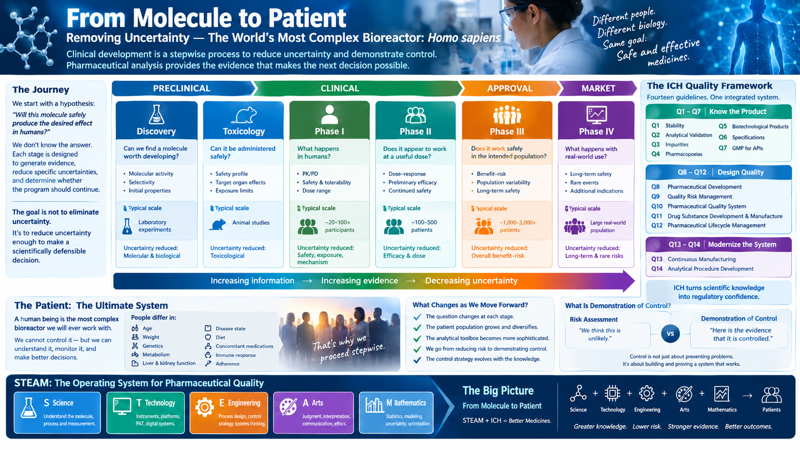
The regulations section framed ICH as the machinery for turning scientific knowledge into demonstrated control. Clinical development is where that knowledge is generated — and the useful way to see it is not as a timeline but as a disciplined process for reducing uncertainty.
The one idea
At the start of a program there is a molecule and a hypothesis:
Will this molecule safely produce the desired effect in humans?
Nobody knows. Each stage of development exists to generate evidence, retire a specific uncertainty, and decide whether to continue. As the program advances, the number of participants grows, the information grows, the analytical toolbox gets more sophisticated, and the decisions get more consequential.
The goal is not to eliminate uncertainty. It is to reduce it enough to make a scientifically defensible decision.
The world’s most complex bioreactor: Homo sapiens
An analyst can control an instrument. A process engineer can control a reactor. The system the drug ultimately enters — the human being — cannot be controlled the same way. People differ in age, weight, genetics, metabolism, renal and hepatic function, disease state, diet, concomitant medications, immune response, and adherence.
That variability is why development proceeds stepwise: a progressively larger and more diverse population is exposed to the medicine as knowledge accumulates.
The clinical development funnel
| Stage | Primary question | Uncertainty being reduced | Typical scale |
|---|---|---|---|
| Discovery | Do we have a molecule worth developing? | Molecular activity, selectivity, properties | Laboratory experiments |
| Toxicology | Can it be administered safely? | Potential toxicity and exposure limits | Animal studies |
| Phase I | What does the molecule do in humans? | PK/PD, safety, dose, exposure | ~20–100+ participants |
| Phase II | Does it appear to work at a useful dose? | Dose–response and preliminary efficacy | ~100–500 patients |
| Phase III | Does it work safely in the intended population? | Benefit–risk at scale | ~1,000–3,000+ patients |
| Phase IV | What happens when millions of people use it? | Long-term and rare risks | Real-world population |
Patient numbers are deliberately approximate — they vary substantially by disease, modality, therapeutic area, and program.
The question changes at every phase
The scale changes, but the more important shift is in the question:
- Discovery — Can this molecule work? Reducing molecular and biological uncertainty.
- Preclinical / toxicology — Is human exposure justified? Reducing toxicological uncertainty.
- Phase I — What happens when humans receive it? Establishing pharmacokinetics (what the body does to the drug), pharmacodynamics (what the drug does to the body), exposure, tolerability, and dose range.
- Phase II — Does it appear to work, and at what dose? Connecting the chain dose → exposure → response → benefit.
- Phase III — Does the benefit outweigh the risk in the intended population? Consequential, because the evidence has to support the intended patients and the eventual label.
- Phase IV — What did we not know? Approval does not mean uncertainty is gone; it means the benefit–risk relationship is acceptable for the proposed use. Real-world use then becomes an enormous additional source of evidence.
Where pharmaceutical analysis fits
This connects straight back to STEAM. Pharmaceutical analysis is one of the mechanisms by which an organization reduces uncertainty and demonstrates control. At every stage it asks the same things — the habit Lecture 1 called science:
- What do we know?
- How do we know it?
- How certain are we?
- What evidence would change the conclusion?
The analytical control strategy evolves with the molecule: characterization → analytical methods → specifications → process understanding → manufacturing controls → clinical testing → stability monitoring → commercial control strategy → post-market surveillance. It is not a static document. It is the accumulated scientific knowledge about the product and process.
Risk assessment vs. demonstration of control
Reducing risk is not the same as demonstrating control.
We think this impurity is unlikely to occur is a risk assessment. We understand how the impurity forms, we measure it with a validated method, we have set a justified specification, we control the process that creates it, and we monitor that process over time — that is demonstration of control.
The analytical scientist’s job is to convert “we think this is controlled” into “here is the evidence that it is controlled.”
Uncertainty decreases — but never reaches zero
Read the funnel as a descent in uncertainty rather than a passage of time: Discovery (many candidate molecules, high uncertainty) → Preclinical (activity and toxicology) → Phase I (human PK/PD and safety) → Phase II (dose and preliminary efficacy) → Phase III (benefit–risk and population variability) → Approval (enough evidence for a regulatory decision) → Phase IV (real-world evidence and rare events) → continuous learning.
Every experiment, analytical result, clinical observation, stability point, deviation, and batch adds information. Uncertainty falls at each step — and never reaches zero.
The connection to ICH
This is the tie back to the regulations section:
ICH is the framework for converting increasing scientific knowledge into increasing control.
- Q1–Q7 establish foundational knowledge and controls around the product — stability, method validation, impurities, specifications, GMP.
- Q8–Q12 move toward development, risk management, quality systems, process understanding, and the recognition that the product keeps evolving across its lifecycle.
- Q13 addresses new approaches to manufacturing.
- Q14 applies the same lifecycle and risk-based philosophy directly to analytical procedures.
So the story of the whole course, in one line:
science → evidence → reduced uncertainty → control → regulatory confidence → patient trust
— and pharmaceutical analysis is present at every link in that chain.
For discussion
- Drug development is not a march toward certainty; it is a disciplined process for reducing it. What does that change about how you’d design a study?
- The weak question is “did the test pass?” The better one is “what did we learn, how much uncertainty did we remove, and is the remaining uncertainty acceptable for the decision in front of us?” Apply that to a single failing stability time point.
- Give an example of something that is risk-assessed but not demonstrated as controlled, and describe the analytical work that would close the gap.