Quality Control — Assuring Quality Across the Supply Chain
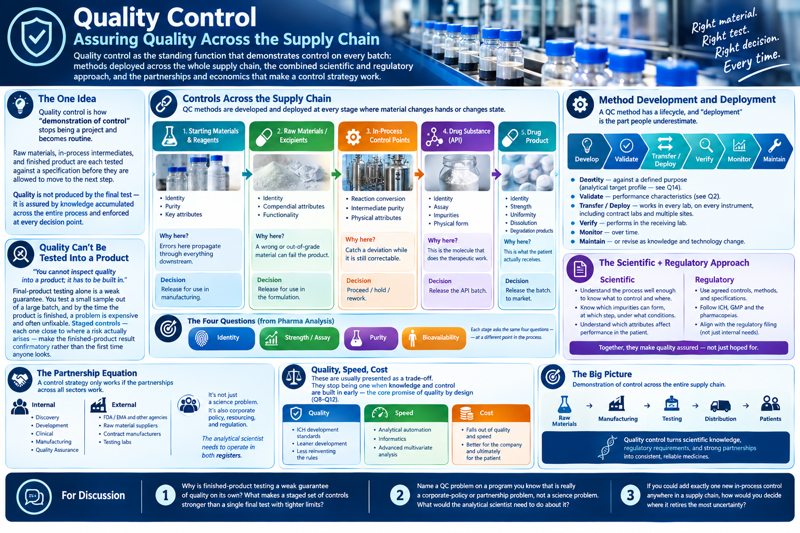
The clinical development section framed development as reducing uncertainty until a program can be approved — a one-time argument built over years. Quality control is the other half: the function that demonstrates control on every batch, every day, for as long as the product is on the market.
The one idea
Quality control is how “demonstration of control” stops being a project and becomes routine. Raw materials, in-process intermediates, and finished product are each tested against a specification before they are allowed to move to the next step. Quality is not produced by the final test — it is assured by knowledge accumulated across the entire process and enforced at every point where a decision is made.
Quality can’t be tested into a product
You cannot inspect quality into a product; it has to be built in.
Final-product testing alone is a weak guarantee. You test a handful of units out of a batch of hundreds of thousands; statistics limit what that sample can tell you, and by the time the product is finished, a problem is expensive and often unfixable. Staged controls — each one close to where a risk actually arises — are what make the finished-product result confirmatory rather than the first time anyone looks.
Controls across the supply chain
QC methods are developed and deployed at every stage where material changes hands or changes state:
| Stage | What is tested | Why here | Decision it gates |
|---|---|---|---|
| Starting materials & reagents | Identity, purity, key attributes | Errors here propagate through everything downstream | Release for use in manufacturing |
| Raw materials / excipients | Identity, compendial attributes, functionality | A wrong or out-of-grade material can fail the product | Release for use in the formulation |
| In-process control points | Reaction conversion, intermediate purity, physical attributes | Catch a deviation while it is still correctable | Proceed / hold / rework |
| Drug substance (API) | Identity, assay, impurities, physical form | This is the molecule that does the therapeutic work | Release the API batch |
| Drug product | Identity, strength, uniformity, dissolution, degradation products | This is what the patient actually receives | Release the batch to market |
Every “what is tested” column traces back to the four questions from Section 2 — identity, strength, purity, bioavailability — asked at a different point in the process.
Method development and deployment
A QC method has a lifecycle, and “deployment” is the part people underestimate:
develop → validate → transfer / deploy → verify → monitor → maintain
- Develop against a defined purpose — an analytical target profile (see Q14).
- Validate the performance characteristics (Q2).
- Transfer / deploy — the method has to give the same answer in every lab that will run it: the developer’s lab, multiple manufacturing sites, contract manufacturers and testing labs, possibly on different instruments. A method that only works where it was born is not deployed.
- Verify it performs in the receiving lab; monitor it over time; maintain or revise it as knowledge and technology change.
The scientific + regulatory approach
Two lenses, both of which must be satisfied:
- Scientific — understand the process well enough to know what to control and where. Which impurities can form, at which step, under what conditions; which attributes affect performance in the patient.
- Regulatory — the controls, methods, and specifications are the ones agreed with the agency and written into the filing (specifications, GMP for APIs). You do not get to change them unilaterally.
Combining knowledge from across the process is what lets quality be assured rather than merely hoped for. And because the regulations — ICH, GMP, the pharmacopeias — apply to every company, they raise the floor for the whole industry: a patient can trust any approved medicine, not just the ones from a manufacturer they happen to know.
Partnerships — the part that isn’t a science problem
Building a QC and control strategy is a complex, multivariate problem, and only some of it is analytical chemistry. It depends on interrelationships between sectors:
- Internal — discovery, development, clinical, manufacturing, and quality assurance, each with its own timeline and priorities.
- External — the FDA, EMA and other agencies; raw-material suppliers; contract manufacturers and testing labs.
Some of the problems in that web are scientific or engineering problems. Others are corporate policy, resourcing, and regulation. A control strategy only works if the partnerships across all of those sectors work — which means the analytical scientist has to be able to operate in both registers.
Quality, speed, cost
These are usually presented as a trade-off. They stop being one when knowledge and control are built in early — the core promise of quality by design (Q8–Q12):
- Quality is driven by the ICH development standards. Leaning on an agreed international framework instead of reinventing one keeps development lean — effort goes into the product, not into arguing about the rules.
- Speed comes from analytical automation and informatics: efficient, reliable reporting and the ability to run advanced multivariate analysis on the data you already collect.
- Cost falls out of the other two. Get quality and speed, and cost drops — for the company and, ultimately, for the patient.
For discussion
- Why is finished-product testing a weak guarantee of quality on its own? What makes a staged set of controls stronger than a single final test with tighter limits?
- Name a QC problem on a program you know that is really a corporate-policy or partnership problem, not a science problem. What would the analytical scientist need to do about it?
- If you could add exactly one new in-process control anywhere in a supply chain, how would you decide where it retires the most uncertainty?